

12
Jul
Why Do My Teeth Get Plaque So Quickly?
Table of Contents
Plaque never stops forming. Bacteria live in every mouth, and they start to collect on clean teeth again soon after you finish. A new layer can begin to form about 4 to 12 hours after you brush. You may brush and floss, and a few hours later your teeth feel coated again. So you ask yourself: Why do my teeth get plaque so quickly?
It can feel faster because missed spots, frequent sugary snacks, and a dry mouth all make buildup harder to control, even when you clean well. If a hard deposit stays after you brush, it may be tartar, and only a dental professional can remove it.
This guide tells you the reasons for quick plaque buildup even after brushing and how to slow it down.
What is Plaque?
Plaque is a soft, sticky film of bacteria that forms on your teeth. Daily brushing and cleaning between teeth remove this film. It is hard to see, so you may notice it first as a fuzzy or slick feeling. Having it does not mean you take poor care of your teeth. If plaque stays long enough, it can harden into tartar and contribute to gum disease that may need scaling and root planning.
Causes of Plaque Buildup
Plaque builds up for a few basic reasons. Here are the main ones:
- Bacteria already live in your mouth, and they begin to settle on clean teeth again soon after you brush.
- Sugars and starches from food and drinks feed these bacteria.
- The bacteria release acids as they feed, and these acids can damage your enamel (ADA MouthHealthy).
- Any film that your brush or floss misses stays on the tooth, most often near the gumline and between teeth.
Plaque vs Tartar
Plaque is soft, and you can remove it at home. Tartar is a hard plaque on teeth, and only a dental professional can remove it.
| Feature | Soft Plaque | Tartar |
| Feel / appearance | Soft, sticky film; often hard to see | Hard, rough deposit; may be discolored |
| Removal | Brushing and cleaning between teeth | Professional removal |
| Next step | Improving cleaning coverage | Arranging an assessment instead of scraping it |
Why Plaque Builds Up Quickly Even After Brushing and Flossing?
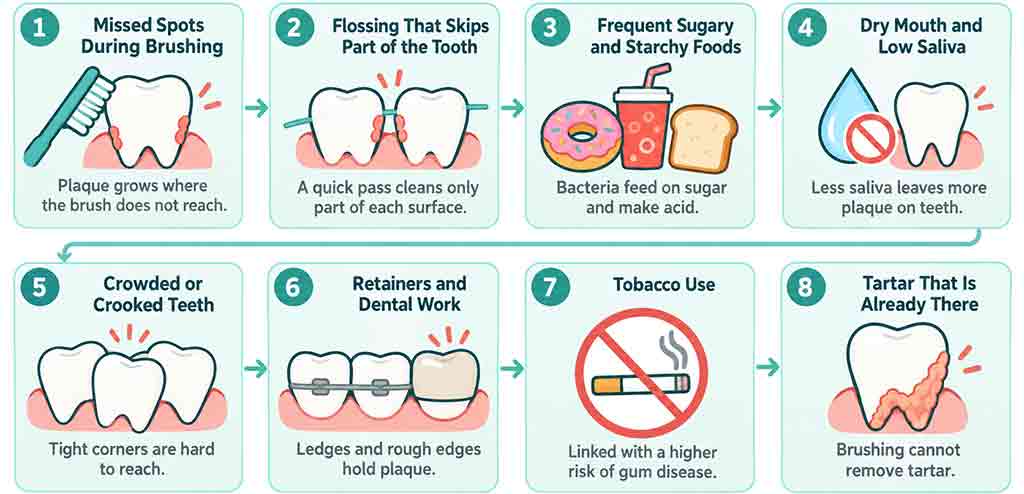
So let’s answer the question: Why do my teeth get plaque so quickly? Plaque comes back for a few common reasons, and most of them have little to do with how hard you try. Here are the main ones:
Missed Spots During Brushing
Plaque buildup even after brushing often comes from spots your brush does not reach, where the film keeps growing between cleanings. The gumline, the inner side of the lower front teeth, and the back teeth are the spots people miss most. Brushing for longer does not fix this, because the problem is coverage, not time.
Flossing That Skips Part of the Tooth
Plaque collects on both sides of the space between two teeth. A quick pass of floss cleans only part of each surface, so the rest stays behind and keeps building.
Frequent Sugary and Starchy Foods
Sweet snacks, soft drinks, bread, and other starches give plaque bacteria sugar to feed on, and the bacteria turn it into acid. Snacking or sipping sweetened coffee and tea throughout the day supplies sugar again and again, so the bacteria stay active for hours. Plain coffee or tea does not do this the way a sweetened drink does.
Dry Mouth and Low Saliva
Dry mouth and plaque are connected. Saliva rinses food off your teeth and helps protect them, so less saliva leaves more plaque on the tooth surface. Some medicines lower saliva, and mouth breathing can dry the mouth out too. Saliva also carries minerals, so it protects teeth overall and plays a part in how tartar forms.
Crowded or Crooked Teeth
Crowded or crooked teeth create tight corners and overlapping surfaces that a brush and floss struggle to reach, so plaque has safe places to stay. This is a cleaning challenge, not a personal failure.
Retainers and Dental Work
Fixed retainers, bridges, and the edges of some crowns or fillings leave small ledges and gaps where plaque can hide. Over time, the edge of a filling or crown can also turn rough, and plaque holds on to a rough surface more easily than a smooth one.
Tobacco Use
Tobacco is linked with heavier plaque and tartar deposits and with a higher risk of gum disease (ADA MouthHealthy). That makes it harder to keep your teeth and gums clean.
Tartar That Is Already There
Hardened tartar sits on the tooth as a rough shell that gives new plaque a surface to cling to. That is why a deposit can seem to return right away when it never came off in the first place. Brushing cannot remove tartar.
Why Some People Build Up More Plaque Than Others
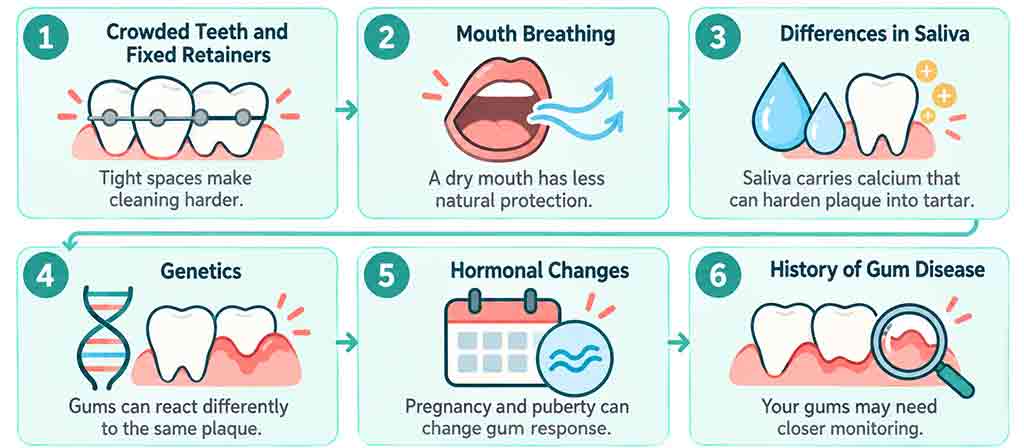
Some people have more places for plaque to collect or need extra help keeping it under control. Top reasons why some people build up more tartar than others include:
- Crowded teeth and fixed retainers create tight spaces and extra surfaces, so dental cleaning takes more effort and plaque has more places to stay.
- Mouth breathing leaves the mouth dry, and less saliva means less of its natural protection.
- Saliva differs from person to person. It carries calcium, and plaque that soaks up that calcium can harden into tartar, so some people form hard deposits more easily than others.
- Genetics can affect how your gums respond to plaque, so the same amount of plaque may leave one person’s gums red and puffy and barely bother another’s.
- Hormonal changes, such as pregnancy and puberty, can change how your gums react to plaque. This does not mean more plaque is forming.
- A history of gum disease or recurring gum swelling means your gums may need closer monitoring, even when your routine is careful.
Needing more frequent care does not mean you have failed at brushing. Some people develop hard deposits despite a careful routine. Your dentist sets your visit schedule after an exam, which may be every 3 or 4 months for some people and about every 6 months for others.
Why is Plaque Behind Bottom Front Teeth More Common?
The plaque behind bottom front teeth happens because:
- This surface is easy to miss. The tongue sits close by, the angle is tight, and a brush often skips the inner side of these small teeth.
- The openings of the salivary ducts sit right beside these teeth. Saliva from these ducts carries minerals, and plaque that stays in place can soak them up and harden into tartar (Dawes, 2006).
Saliva is not the problem here, since it protects your teeth overall. Plaque can harden behind the lower front teeth when some of it stays in place. A hard ridge there that brushing does not remove may be tartar, and a dental professional can check it and remove it.
How to Slow Down Plaque Buildup
You cannot stop plaque from forming, but you can keep it from piling up. These steps can help:
- Use a disclosing tablet to see what you miss. Chew it after you brush, and the color shows where plaque remains (NIDCR). It points out cleaning gaps and does not diagnose a problem.
- Brush twice a day for two minutes with a soft brush and fluoride toothpaste. Angle the bristles about 45 degrees toward the gumline, clean the outer, inner, and chewing surfaces, and hold the brush upright for the inside of the front teeth (ADA MouthHealthy). A manual or powered brush both work.
- Clean between your teeth every day with floss or another between-teeth cleaner. Curve floss around each tooth and clean each side gently.
- Rinse with plain water after you eat if you cannot brush right away. A therapeutic mouthrinse can be an optional extra, but it does not replace brushing or cleaning between teeth (ADA).
- Cut back on repeated sugary snacks and drinks. Try not to snack all day or sip sweetened drinks again and again.
- Keep your professional visits. Brushing cannot remove tartar that has already formed, and plaque can begin to harden within about 24 hours in some cases (Cleveland Clinic). Your dentist sets how often you need cleanings.
When Should You See a Dentist About Fast Buildup?
If you brush and floss but still get plaque or you see a hard deposit near your gums, it is worth checking, even if it does not hurt. Book a dental visit if buildup comes with any of these signs:
- Your gums bleed when you floss.
- Your gums feel tender or look swollen.
- Your gums pull back from your teeth.
- Your bad breath does not go away.
- One spot on a tooth feels newly sensitive.
- An adult tooth feels loose, which needs prompt assessment.
These signs can have several causes, and they can point to gum disease (NIDCR), so a dentist needs to check them. Tartar can collect above or below the gumline, so you cannot judge the problem by how much you can see.
Get Help With Recurring Plaque
So why do my teeth get plaque so quickly? Plaque forms continuously, so a new layer builds up within hours of cleaning. Missed spots, frequent sugar, and a dry mouth speed it up, and only a dental professional can remove tartar.
At My Dental & Implants, Dr. Nima Afzalian, D.M.D., a general dentist, offers dental cleaning and scaling and root planing in Glendale. He also provides implants, restorative dentistry, full mouth rehabilitation, and crowns (license D011364).
Call us at (623) 300-2550, book online, or visit 6637 W Peoria Ave, Suite D-2, Glendale, AZ 85302.
This guide is not a substitute for personalized dental advice. Always follow the instructions your treating dentist gives you.
FAQs
My teeth keep getting plaque so quickly, why?
Plaque returning after dental cleaning is normal because bacteria start to collect on clean teeth again within hours. Missed spots, sugary snacks, and a dry mouth make it feel faster.
How fast does plaque form on teeth?
A new layer can begin to form about 4 to 12 hours after you brush (Dentalcare). That is a rough guide, since plaque forms continuously throughout the day.
How quickly does plaque form?
Plaque forms within hours, and in some cases it can begin to harden into tartar within about a day if it stays in place. Daily cleaning keeps it thin.
How does tartar impact oral health?
Hard tartar holds on to plaque and makes cleaning harder. The bacteria in that plaque can irritate your gums, so ongoing gum problems need a dental exam.
How do I stop getting plaque on my teeth?
You cannot stop it, since plaque forms naturally. Brush twice a day, clean between your teeth daily, snack on sugar less often, and follow your dentist’s advice.
Can you 100% prevent tartar?
No. Daily plaque removal lowers buildup, but saliva, hard-to-reach areas, and personal risks all affect the result. Regular dental visits remove tartar that does form.
Can you reverse plaque on your teeth?
You can remove soft plaque by brushing and cleaning between teeth. You cannot brush away hardened tartar, and removing plaque does not undo cavities or advanced gum damage.
Is it okay to scrape plaque off teeth?
No. Sharp tools can hurt your gums and teeth. Brush and clean between teeth for soft plaque, and have a dental professional check any hard deposits.
Are you prone to tartar buildup?
You may be if hard deposits keep returning, you wear a retainer, or parts of your mouth are hard to reach. A dental exam shows what you need.
Can medications make my teeth feel coated?
Some medicines reduce saliva, which can leave your mouth dry and sticky. Tell your dentist, and never stop a medicine without advice from your prescribing doctor.
Do I need cleanings more often if tartar returns quickly?
Possibly. Your dentist sets the schedule based on your deposits, gum health, and history. Some people need visits every 3 or 4 months, but not everyone.
Is fast plaque buildup bad?
Plaque forming is normal. A deposit that stays or symptoms that last matter more, so see your dentist for hard buildup, bleeding, or swelling.
How quickly does plaque form?
How quickly plaque forms varies, but a new layer can start within hours of brushing. In some cases, it begins to harden into tartar within about a day.
Share this Article

Dr. Nima Afzalian's
Dr. Nima Afzalian's
journey in dentistry began at 12 when he experienced the transformative power of
dental care during a tooth-filling procedure. That pivotal moment ignited his passion for dentistry, and
he has since dedicated his life to making a difference in people's lives by relieving pain and
discomfort through his expertise.
Nima earned his bachelor's and master's degrees in Biomedical Engineering from the
prestigious Barrett
Honors College at Arizona State University. Subsequently, he obtained his dentistry doctorate
from the
Midwestern College of Dental
Medicine, graduating with honors, with recognition in Dental Implants and
the Dean's Award as the Top Clinician of his class.
With his extensive education, clinical excellence, and genuine dedication to patient well-being, Dr.
Nima Afzalian is excited to provide you with the highest level of care for all your dental needs. When
you choose Dr. Nima, your oral health is in capable hands!
Success Stories
We are blessed with clients and patients who are loyal to us and have the nicest things to say about us.
Translate »