
13
Aug
Can a Super-Erupted Tooth Be Saved?
If a dentist just told you that one of your teeth has “super-erupted,” your first thought was probably: Can a super-erupted tooth be saved? In a nutshell, often, but not always. Many super-erupted teeth can be treated and kept, though the right course of treatment depends on your specific case. What happens next depends on how far the tooth has moved, how much bone and root support is left, and the condition of the tooth and gums around it.
What is Super Eruption Teeth?
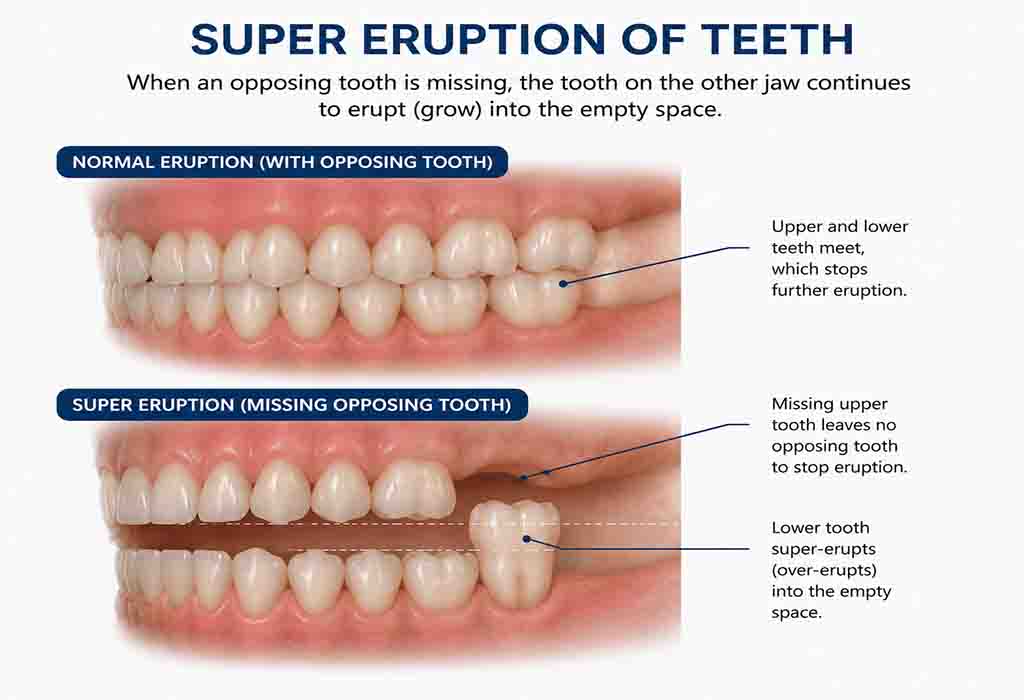
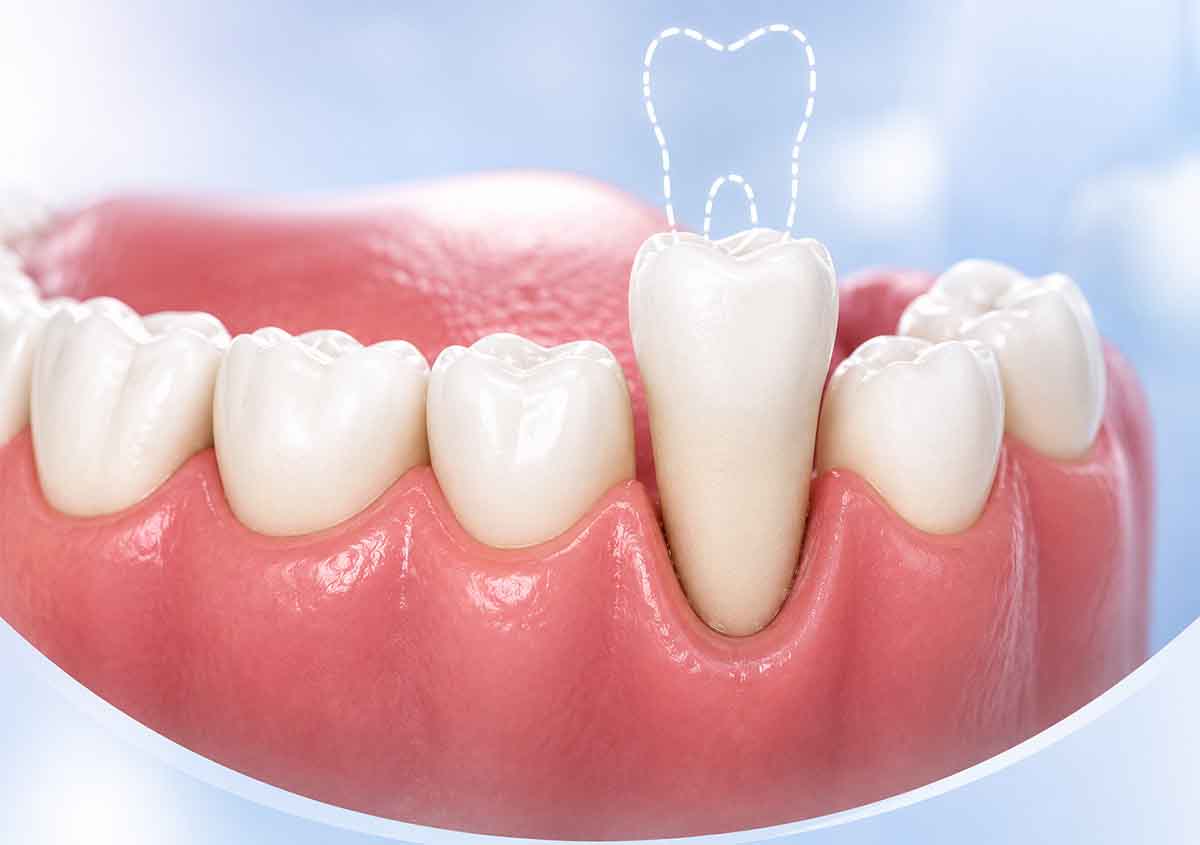
A tooth normally erupts, or grows into place, until it meets the tooth across from it. That contact is what stops it. If the opposing tooth is missing and never replaced, there is nothing to stop the tooth from continuing to grow. Dentists call this supereruption, overeruption, or supraeruption.
Over time, a super-erupted tooth can look noticeably longer than the teeth next to it. In more advanced cases, it can grow far enough to touch the gum tissue in the empty space across from it every time you bite down.
Possible Causes of Super-Eruptions
The most common causes you have an over erupted tooth are:
- A missing opposing tooth that was never replaced. The leading cause.
- A worn-down or damaged opposing tooth that no longer makes contact.
- An old crown, filling, denture, or partial that no longer fits or sits correctly.
- A bite that is already uneven or out of alignment.
- Gum disease that has weakened the bone, letting the tooth drift.
- Rarely, a tooth that never erupted into the right spot to begin with.
It’s also a reason some dentists recommend removing an upper and lower wisdom tooth together, even when only one is causing problems, since leaving one without a partner on the opposite arch can lead to this condition years later.
Super Erupted Tooth Symptoms
Spot super eruption of teeth by watching for:
- A tooth that looks noticeably longer than the ones beside it
- Food catching around that tooth more than it used to
- Soreness near the gumline, or a root surface that looks exposed
- A tooth that feels slightly loose or that changes how your bite feels.
- In more advanced cases, the tooth biting into the gum or cheek tissue on the opposite side when you chew
Many people first learn they have this condition during a routine checkup, or during a consultation for an implant or denture on the opposite side.
Can a Super-Erupted Tooth Be Saved? Here’s What Decides the Answer
Yes, usually, but not always. A dentist looks at four things to decide:
- How far the tooth has moved. A small amount of movement is much easier to correct than a large amount.
- How much root length and bone support are still holding the tooth in place.
- Whether the gum tissue around the tooth is healthy, or whether gum disease is already present.
- The condition of the tooth itself, including any decay, cracks, or old dental work.
Many super-erupted teeth, even ones that look alarming at first, can be treated and kept. Others, usually where the tooth has moved a great deal or lost significant bone support, need to come out. A clinical exam is the only way to know which applies to your tooth. The only way to know which situation applies to your tooth is a clinical exam and, usually, an X-ray.
Interestingly, research backs this up. A peer-reviewed study (Kim et al., 2016) followed dental implants placed opposite untreated super-erupted teeth and found highly favorable outcomes, with only about 0.09 mm of bone loss on average over two and a half years. So a dentist may sometimes choose to watch a case instead of treating it aggressively, depending on what your exam shows.
Super Eruption Tooth Treatment
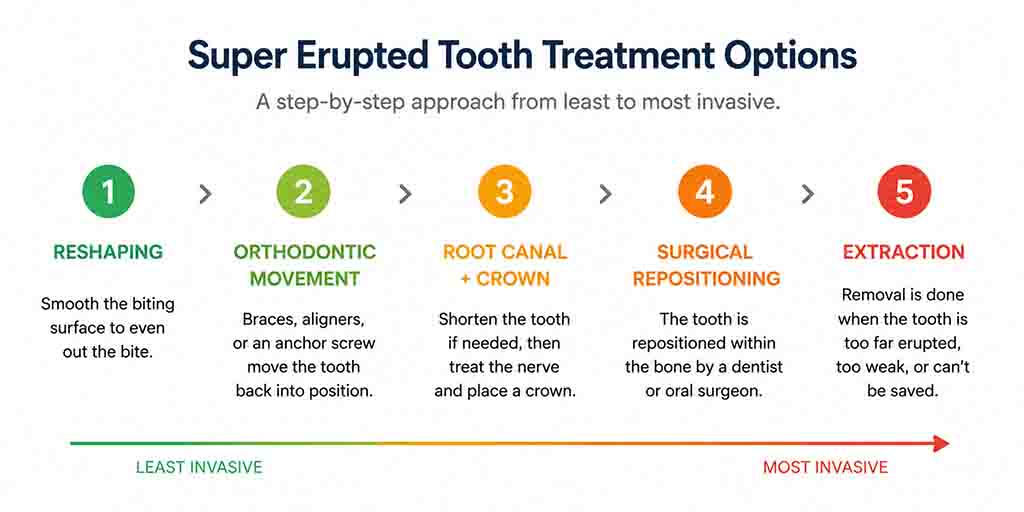
Here are the treatment options, from the simplest to the most involved. Treatment planning generally favors the least invasive option that will work for your tooth, though the right starting point depends on your exam:
Reshaping (Coronoplasty)
For mild cases, a dentist gently smooths down the biting surface to even out the bite, a process called coronoplasty. This can often be done in one visit.
Orthodontic Intrusion (Braces or Aligners)
Braces or clear aligners gradually guide the tooth back into the correct position. For extra control, a dentist may add a small anchor screw called a Temporary Anchorage Device (TAD), which gives the tooth something firm to pull against. This approach preserves most of the tooth’s own structure and usually takes a few months.
Root Canal Therapy and Crown Lengthening
If the tooth needs to be shortened more than reshaping alone allows, that reduction can reach the nerve. A root canal removes the infected or damaged nerve tissue from inside the tooth, and the gum and bone around it are often trimmed slightly so there’s enough room for a crown afterward.
Surgical Repositioning
In select cases, a dentist or oral surgeon can reposition the tooth within the bone itself. This option is usually considered when orthodontic movement alone would take too long or is not practical, but the tooth still has enough healthy support to be worth saving.
Super Erupted Tooth Extraction
Removal is typically considered when a tooth has moved too far, is too weak, or no longer has enough bone and gum support to restore predictably.
Replacing the missing tooth that caused the super-eruption in the first place is part of the plan too, whether that means an implant, a bridge, or Invisalign if the bite also needs correcting. Treating the super-erupted tooth alone, without replacing what’s missing on the other side, often leads to the same problem returning over time.
When a Super-Erupted Tooth Can’t Be Saved
Sometimes a tooth genuinely cannot be saved. This usually happens when there has been:
- Significant bone loss
- Active gum disease
- The tooth is already cracked or badly decayed.
- The tooth has already drifted too far to move back safely.
If that turns out to be the case for your tooth, a dental implant is typically the most reliable way to replace it and prevent the same problem from starting on a neighboring tooth. Extraction followed by a well-planned replacement is a legitimate outcome, not a failure.
What Happens If You Leave It Untreated
If you leave a hyper-erupted tooth untreated:
- The tooth keeps moving further out of position over time.
- Neighboring teeth can start to shift as your bite changes.
- The exposed root surface becomes more sensitive and more prone to decay.
- Fitting an implant or bridge on the opposite side later can become harder, since there may not be enough room left.
- In advanced cases, the tooth can start biting into the gum tissue across from it every time you chew, which is uncomfortable and can cause further damage the longer it goes on.
How to Prevent a Tooth From Super-Erupting
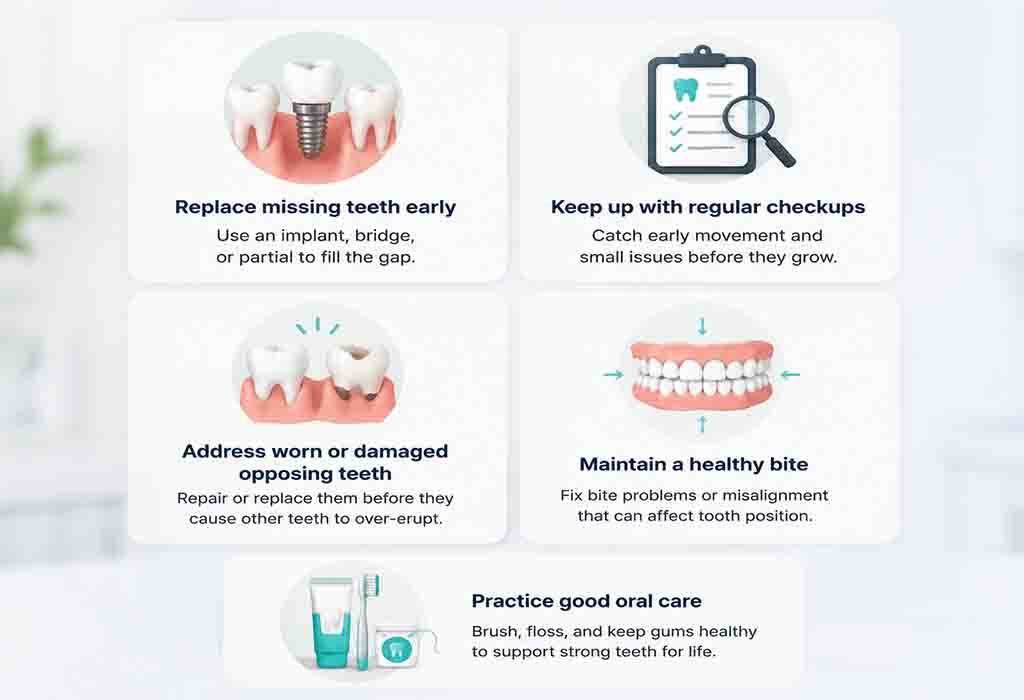
Preventing this is usually easier than treating it. A few simple habits go a long way toward keeping your bite even and your teeth in the right position.
Get Your Tooth Evaluated at My Dental & Implants
Can a super-erupted tooth be saved? Yes, but not always. A super-erupted tooth is rarely as urgent as it feels. Many cases can be treated and kept, and when extraction is needed, a well-planned replacement can still restore your bite. An exam is the only way to know which path applies to you. The only way to know for sure is an exam.
At My Dental & Implants, Dr. Nima Afzalian treats super-erupted teeth by starting with whatever option preserves the most of your natural tooth, and moving to more involved treatment only if that’s what the case requires. That can mean reshaping, Invisalign, a root canal and crown, or, if needed, an extraction and dental implant. Treatment planning typically starts with X-rays to check your root and bone support.
If you’re in Glendale, Peoria, or Phoenix and a dentist mentioned a super-erupted tooth, or you’ve noticed one yourself, don’t wait. Call My Dental & Implants at (623) 300-2550 or visit us at 6637 West Peoria Ave Suite D-2, Glendale, AZ 85302 to schedule an exam.
FAQs
Can a super-erupted tooth be saved without surgery?
Often, yes. Mild cases can sometimes be managed with reshaping or with braces or aligners, both of which avoid surgery. More severe cases may need surgical repositioning or extraction.
Does a super-erupted tooth need to be extracted?
Not automatically. Extraction is usually reserved for teeth with severe movement, significant bone loss, or advanced decay that make other treatments unpredictable.
How long does treatment for a super-erupted tooth take?
It depends on the method. Reshaping can be done in a single visit. Moving the tooth back into place with braces or aligners typically takes several months, since a tooth has to be moved slowly to stay healthy.
Can a super-erupted tooth cause pain?
It can, especially if the root surface is exposed or the bite is significantly off. Many cases cause more of a food-catching or cosmetic concern than real pain, at least at first.
How do you fix a super-erupted tooth?
Treatment follows a scale based on how severe the case is: reshaping for mild cases, braces or aligners for moderate cases, a root canal with a crown when more of the tooth needs to be shortened, surgical repositioning in select cases, and extraction only when the tooth cannot be restored predictably.
Share this Article

Dr. Nima Afzalian's
Dr. Nima Afzalian's
journey in dentistry began at 12 when he experienced the transformative power of
dental care during a tooth-filling procedure. That pivotal moment ignited his passion for dentistry, and
he has since dedicated his life to making a difference in people's lives by relieving pain and
discomfort through his expertise.
Nima earned his bachelor's and master's degrees in Biomedical Engineering from the
prestigious Barrett
Honors College at Arizona State University. Subsequently, he obtained his dentistry doctorate
from the
Midwestern College of Dental
Medicine, graduating with honors, with recognition in Dental Implants and
the Dean's Award as the Top Clinician of his class.
With his extensive education, clinical excellence, and genuine dedication to patient well-being, Dr.
Nima Afzalian is excited to provide you with the highest level of care for all your dental needs. When
you choose Dr. Nima, your oral health is in capable hands!
Success Stories
We are blessed with clients and patients who are loyal to us and have the nicest things to say about us.
Translate »