
27
Jul
Dental Implants With Bone Loss: Is It Possible?
Your denture slips when you eat, so you think of getting implants. But your dentist tells you there is not enough bone for implants. So can you get dental implants with bone loss? Yes, many people can.
During the process, the dentist may rebuild the bone with a graft or sinus lift, use implants for thinner bone, or anchor them in stronger parts of the jaw, based on how much bone you have left. The exam and the 3D scan help the dentist decide which route fits you.
Does Bone Loss Mean No Implants?
Not always. After a tooth is lost, the bone around its root can shrink, so the dentist measures your bone first. If there is enough, the plan is simple. If not, many dentists can add a graft to add bone where it is gone or plan around thin areas of the jaw. It depends on how much bone you have left, where it sits, and how well you heal. A few people are not candidates for dental implant bone loss methods, and only an exam with a 3D scan can show which group you are in.
Causes of Bone Loss
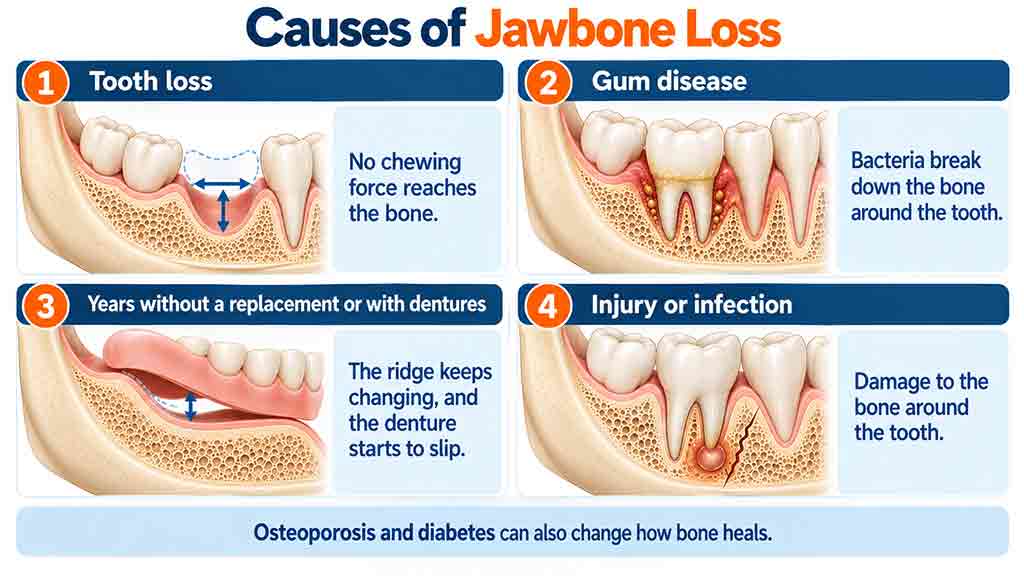
The jawbone loss causes are usually easy to trace:
Tooth Loss
Your jawbone stays full because your tooth roots pass chewing force into it. When a tooth is gone, that force stops, and the bone around the empty space starts to shrink (AAOMS). This is why the jawbone shrinks after tooth loss.
A 2012 review found the ridge lost about 3.8 mm in width and 1.2 mm in height within 6 months (Tan et al.). The amount differs from person to person.
Gum Disease
Bacteria below the gumline break down the bone that holds your teeth. The damage can stay after the tooth falls out. Dentists treat gum disease first so your gums are healthy before surgery.
Years Without a Replacement or With Dentures
The longer a gap stays empty, the more the jaw changes. Dentures and bone loss go together for this reason. As the ridge shrinks, a denture starts to slip, and it may need a reline or a remake.
Injury or Infection
A hit to the jaw or an infection near a tooth root can damage the bone around it. Health conditions such as osteoporosis and diabetes also change how bone heals.
How Much Bone Do You Need for Dental Implants?
How much bone is needed for dental implants depends on the implant size and where it goes. The dentist checks your bone height and width, plus the distance to the sinus in the upper jaw and the main nerve in the lower jaw. The table below is a general guide.
| Bone level | What the ridge looks like | General guide | Implants possible? |
| Enough bone | Wide and tall enough for a standard implant | A standard implant fits | Yes, often with no extra step |
| Mild to moderate loss | Thin or short in places | A small graft, a sinus lift, or a narrower implant | Often yes |
| Severe loss | Very thin or little height left | A larger graft or a different implant design | Sometimes. A few people are not candidates |
How Much is Too Much Bone Loss for Implants?
With bone loss and dental implants, no single number sets how much is too much. If so much bone is gone that no graft or other design can give the implant a stable base, implants may not be possible. This is uncommon, and only an exam and a 3D scan can tell. Weak bones can make the surgery fail (Mayo Clinic). In that case, your dentist can talk with you about other ways to replace lost teeth, such as a denture that fits well or a bridge.
Solutions for Dental Implants with Bone Loss
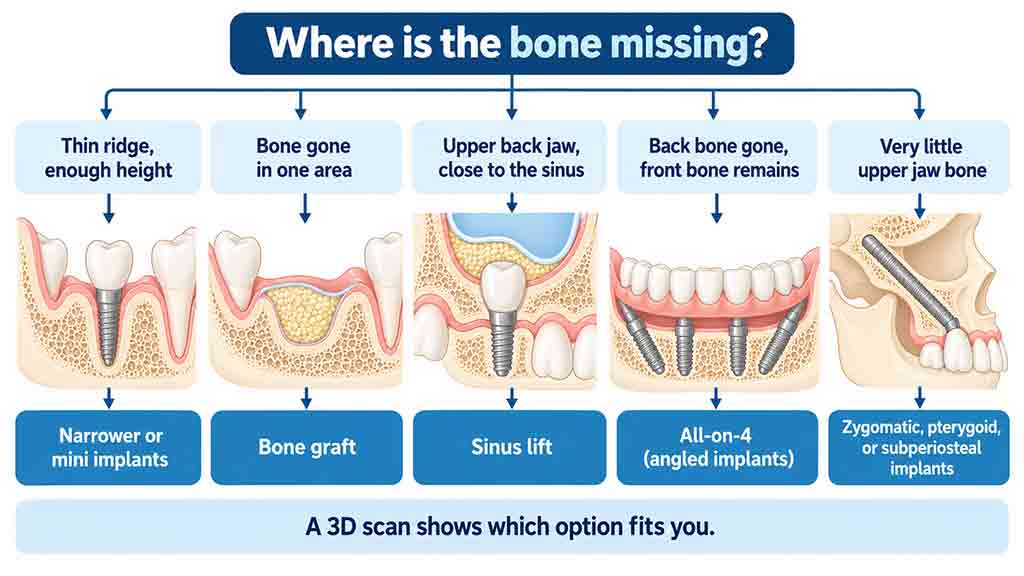
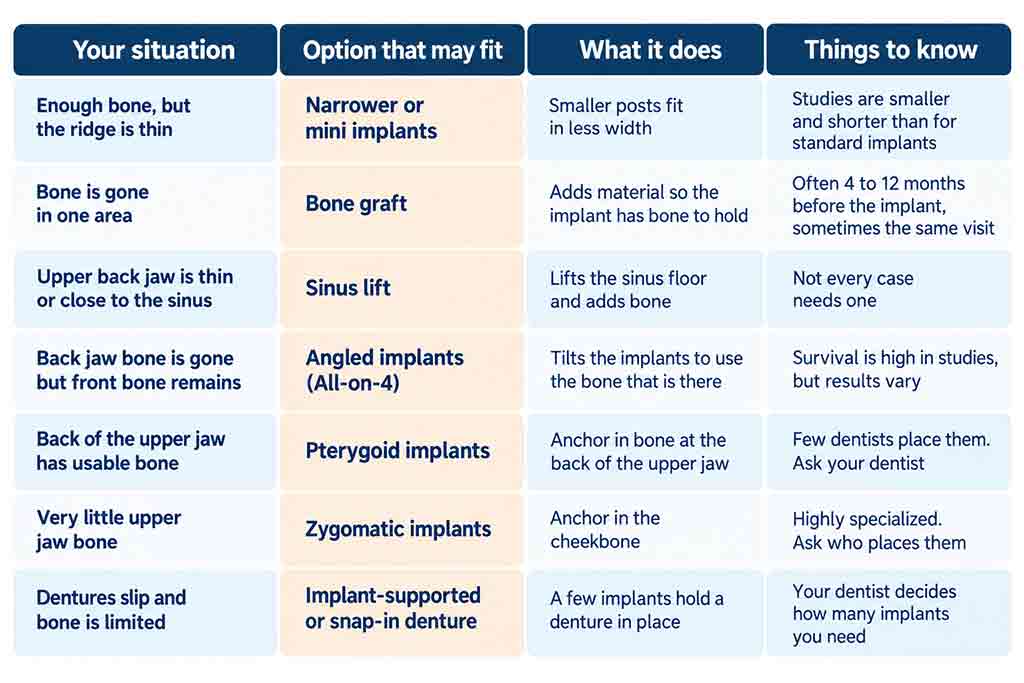
There is no single choice for everybody. The right bone loss dental implant options depend on where the bone is gone, how much is gone, and your health.
Using the Bone You Have (All-on-4)
Some people can get dental implants without bone grafting because the dentist plans around the bone that is already there. All-on-4 places implants at an angle so they reach denser bone in the front of the jaw, which is why All-on-4 with bone loss can work. A review of 25 studies found 94% to 98% implant survival over 6 to 11years, mostly in single-center studies of people with no teeth (All-on-4 review). Results vary from person to person, and these studies do not predict your result.
Narrower and mini implants need less width. A snap-in denture clicks onto a few implants and stays steady in the upper or lower jaw. The research is stronger for some of these options than others.
Bone Grafting for Dental Implants
A bone graft adds material so the implant has bone to hold. Dentists use four kinds:
| Graft material | What it is |
| Your own bone | Taken from another place in your body or mouth |
| Human donor bone | Processed bone from a tissue bank (allograft) |
| Animal bone | Treated animal bone (xenograft) |
| Synthetic material | Man-made bone material (alloplast) |
A graft placed when a tooth comes out is called socket preservation. Ridge augmentation builds up a ridge that is thin or short. After a ridge graft, bone usually needs about 4 to 12 months to grow before the implant. Sometimes the dentist places the implant at the same visit.
Sinus Lift for Dental Implants
A sinus lift raises the floor of the sinus and adds bone, so implants can go in the upper back jaw. Bone loss often follows gum disease or tooth loss in this area. The dentist lifts the thin tissue of the sinus floor, adds graft material under it, and lets the area heal. Bone usually needs about 4 to 12 months to grow, and sometimes the implant goes in at the same visit.
Zygomatic, Pterygoid, and Subperiosteal Implants
They are often used when bone loss is severe. When the upper jaw has very little bone, some dentists anchor implants in other strong bones:
- Zygomatic implants anchor in the cheekbone.
- Pterygoid implants anchor in the bone at the back of the upper jaw, and the dentist pairs them with other implants.
- A subperiosteal implant is a custom metal frame that sits under the gum, on top of the bone.
My Dental & Implants does not place these implants.
How Long Does the Whole Process Take?
A dental implant timeline with bone graft depends on how much bone the dentist must rebuild. These are typical ranges for various types of bone loss:
- Mild: The graft and implant may go in at the same visit, then the implant needs a few months to bond.
- Moderate: Bone often needs 4 to 12 months to grow, then a few more months for the implant to bond.
- Severe: A larger graft or a different design makes the process longer.
Smoking and diabetes can add time. You may wear a temporary denture or partial while you heal.
Challenges of Getting Dental Implants With Bone Loss
Bone loss is the main challenge, but health and habits matter too. Here is what can make treatment harder:
- Thin, soft, or damaged bone gives the implant less to grip, so it may feel loose or fail to bond.
- A graft may not take, which can mean a second graft, a different material, or another option.
- The implant sits close to the sinus in the upper jaw and to a nerve in the lower jaw, so the dentist uses the 3D scan to plan the position.
- Bone needs time to heal after a graft, so treatment takes longer than a standard implant.
- Dental implants for diabetics with bone loss carry a higher risk because diabetes slows healing and worsens gum disease.
- Smoking about doubles the risk of gum disease. Smoking may also contribute to implant failure.
- Untreated gum disease can damage the bone around the implant, so it needs treatment first.
- Grinding or clenching your teeth puts extra stress on implants and may damage them.
What Do Dental Implants With Bone Loss Cost?
Bone work adds a step and a fee to your plan, so dental implants with bone grafting often cost more than a standard implant, and the total varies from person to person. Costs vary from person to person. Here are the main things that change the total:
- The number of implants you need
- Whether you need a graft or a sinus lift
- The 3D scan
- Sedation
- The type of replacement teeth, such as a single crown, a bridge, or a full denture
What to Expect at Your Consultation
A dental implant consultation answers one question: is there enough healthy bone and gum to hold an implant? Here is what the dentist does:
- Reviews your health history and your medicines, including diabetes and osteoporosis.
- Checks your gums, teeth, and the spaces where teeth are gone.
- Takes an X-ray to see the overall shape of your jaw.
- Takes a 3D scan to measure bone height and width and the distance to the sinus and nerves.
- Explains the scan results and what an implant evaluation shows about your bone.
- Gives you a written plan with each step, the order, the timeline, and the cost.
Bring a list of your medicines and any X-rays from other dentists.
Ready to Find Out How Much Bone You Have? Book a Consultation in Glendale
At My Dental & Implants, Dr. Nima Afzalian starts with an exam, a health review, and an X-ray or 3D scan to measure how much bone you have left. He then explains which path fits your case, such as a standard implant, a graft, a sinus lift, or All-on-4.
We help patients with dental implants in Glendale and from Peoria, Surprise, and Sun City.
Visit us at 6637 West Peoria Ave, Suite D-2, Glendale, AZ 85302, call (623) 300-2550, or book an appointment online to schedule your consultation.
Services provided by an Arizona-licensed general dentist.
Frequently Asked Questions
Can you get implants if you have worn dentures for years?
Often, yes. Bone shrinks over time, but a graft or a plan built around thinner bone may still work. A 3D scan shows how much bone is left.
Can you get dental implants without a bone graft?
Sometimes. Narrower or angled implants may work with less bone. If the ridge is too thin or short, a graft or sinus lift may be needed.
Can you have dental implants with severe bone loss?
Often, yes. A larger graft, a sinus lift, or implants anchored in stronger bone can make it possible. A few people are not candidates, and a 3D scan shows which group you are in.
Can you get implants if you take osteoporosis medicine?
Often, yes. These medicines do not appear to rule out implants, and jaw problems are rare. The ADA reports jaw problems in about 0.001% to 0.01% of people who take oral bisphosphonates. Medicines given by IV or injection call for more caution.
How long after a bone graft can you get an implant?
Bone usually needs about 4 to 12 months to grow after a ridge graft or sinus lift. Sometimes the implant goes in at the same visit.
Do dental implants stop bone loss?
Implants do not stop bone loss in every case, and gum disease or heavy grinding can still change the bone. Gum disease or heavy grinding can still change the bone.
Am I too old for dental implants with bone loss?
No. Age alone is usually not the barrier, and overall health matters more.
What should I do if I do not have enough bone for dental implants?
Get a 3D scan to see how much bone is left. Many people can still get implants after a bone graft or sinus lift, or with narrower or angled implants.
Does Medicare cover dental implants?
Original Medicare does not cover dentures or implants (Medicare.gov). Some Medicare Advantage plans may offer dental as an added benefit (CMS), so ask your plan what it covers and what the limits for bone loss implants are.
Share this Article

Dr. Nima Afzalian's
Dr. Nima Afzalian's
journey in dentistry began at 12 when he experienced the transformative power of
dental care during a tooth-filling procedure. That pivotal moment ignited his passion for dentistry, and
he has since dedicated his life to making a difference in people's lives by relieving pain and
discomfort through his expertise.
Nima earned his bachelor's and master's degrees in Biomedical Engineering from the
prestigious Barrett
Honors College at Arizona State University. Subsequently, he obtained his dentistry doctorate
from the
Midwestern College of Dental
Medicine, graduating with honors, with recognition in Dental Implants and
the Dean's Award as the Top Clinician of his class.
With his extensive education, clinical excellence, and genuine dedication to patient well-being, Dr.
Nima Afzalian is excited to provide you with the highest level of care for all your dental needs. When
you choose Dr. Nima, your oral health is in capable hands!
Success Stories
We are blessed with clients and patients who are loyal to us and have the nicest things to say about us.
Translate »