
20
Aug
Can You Use Vanilla Extract for a Toothache?
Your tooth hurts, it is late, and someone told you a dab of vanilla extract from the pantry can help. But seriously, can you use vanilla extract for toothache? Yes, in a small way. The alcohol in real vanilla extract can numb the surface of your gum for a few minutes, but it does not treat the cavity, crack, or infection actually causing your pain.
This guide covers how vanilla extract for tooth pain works, how to use it safely, what it will not fix, and when to stop trying home remedies and call a dentist.
Does Vanilla Extract Help Toothache?
Vanilla extract has no active pain-relieving ingredient, but it can give brief, mild relief, only because of the alcohol it contains, not from anything in the vanilla itself.
Real vanilla extract sold in the US must contain at least 35 percent alcohol, and that alcohol is what causes the effect people notice (U.S. FDA standard of identity for vanilla extract, 21 CFR 169.175). On contact with your gum, it works much like the alcohol in a mouthwash or an old-fashioned dab of whiskey on a sore tooth. It dries the top layer of tissue for a moment, which dulls feeling right at the surface, and it has a mild antiseptic effect that can clean the area slightly.
Note: No published research has tested vanilla extract as a home remedy for toothache, so any relief people report is personal experience, not proven fact.
Some sources call vanilla an antioxidant or a natural disinfectant. Neither one helps a toothache. Vanillin, the compound behind vanilla’s flavor, has no evidence behind it for pain relief. The alcohol does the work, not the vanilla flavor itself.
Vanilla’s smell can feel calming when you are in pain, and that comfort is real. A pleasant smell does not numb your tooth or fix anything wrong with it, though, so do not count on it as a treatment.
How Do I Use Vanilla Extract for a Toothache Safely?
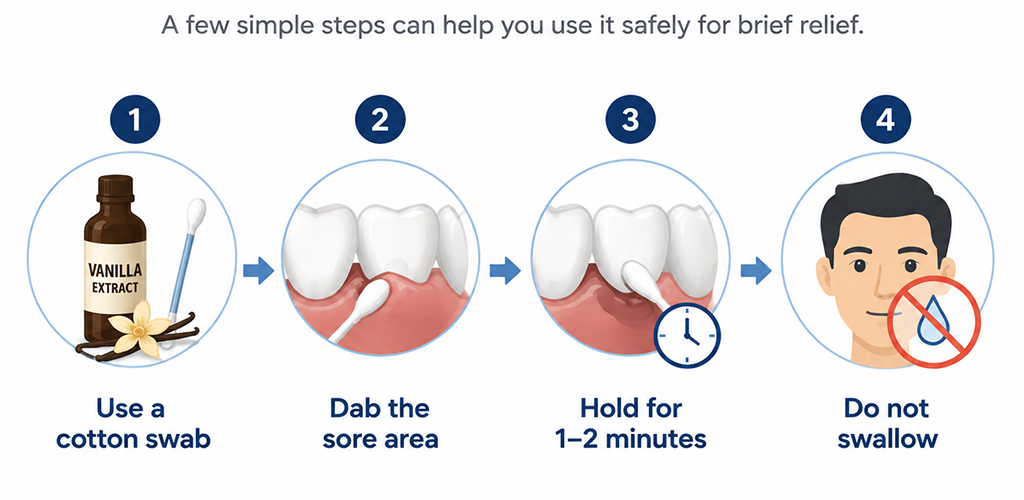
A few simple steps make this natural toothache remedy safer to try:
- Use real vanilla extract, not imitation. Imitation usually has little or no alcohol.
- Dab a small amount onto a cotton ball or a cotton swab instead of pouring it into your mouth.
- Hold it against the sore spot for a minute or two instead of rubbing it in.
- Do not swallow more than a drop or two.
- Use it as a short-term fix only, not a reason to skip finding out what is actually wrong.
A dab before bed can help you fall asleep while you wait for an appointment, and that is a fine way to use it. It is not a treatment, though, and should not turn into a nightly habit. If you need it every night, that itself is a sign to call a dentist.
Can You Use Imitation Vanilla Extract for a Toothache?
Check the label first. Real vanilla extract must contain at least 35 percent alcohol by law. Imitation vanilla extract skips that rule entirely, since it usually swaps in water or propylene glycol as the base and relies on synthetic vanillin for flavor, often with little or no alcohol at all. Without that alcohol, imitation vanilla extract likely will not give you even the mild numbing effect real vanilla extract can, so it is not worth trying for a toothache.
One quick way to tell them apart on the shelf: look for the word “extract” rather than “flavor.” Bottles labeled “imitation vanilla flavor” are the ones that skip the alcohol, while “pure vanilla extract” is the one that meets the 35 percent minimum.
Precautions, Side Effects, and Risks
A few real risks are worth knowing before trying vanilla extract for a toothache:
- Not safe for children, since the alcohol content is too strong for a child’s mouth.
- Skip it if you have a mouth sore, ulcer, or a recent extraction site, since alcohol can irritate healing tissue.
- Frequent use can dry out or irritate your gums.
- A few people feel a burning or stinging sensation even on healthy gum tissue, not just on an exposed nerve, so try a small amount first.
- If you are pregnant, breastfeeding, or avoiding alcohol for personal or medical reasons, ask your dentist about an alcohol-free option instead.
- It does nothing for the actual cause, so relying on it can let a cavity, infection, or crack get worse.
- Avoid it inside an open cavity or directly on exposed nerve tissue, where the alcohol can sting sharply.
What Vanilla Extract Will Not Fix
Vanilla extract does nothing for tooth decay, cracked tooth, failed filling, gum infection, or dental abscess, which actually cause most toothaches. Left alone, these problems only get worse, since decay keeps spreading and an infection can move beyond the tooth into the jaw or bloodstream. Vanilla extract will not stop an abscess from growing, close a crack, or save a nerve that is dying inside the tooth.
Finding the real cause takes an exam and often an X-ray. Depending on what your dentist finds, the actual fix might be a filling, a crown, a root canal, or a tooth extraction. No home remedy, including vanilla extract, replaces that step.
Other Home Remedies for Toothaches
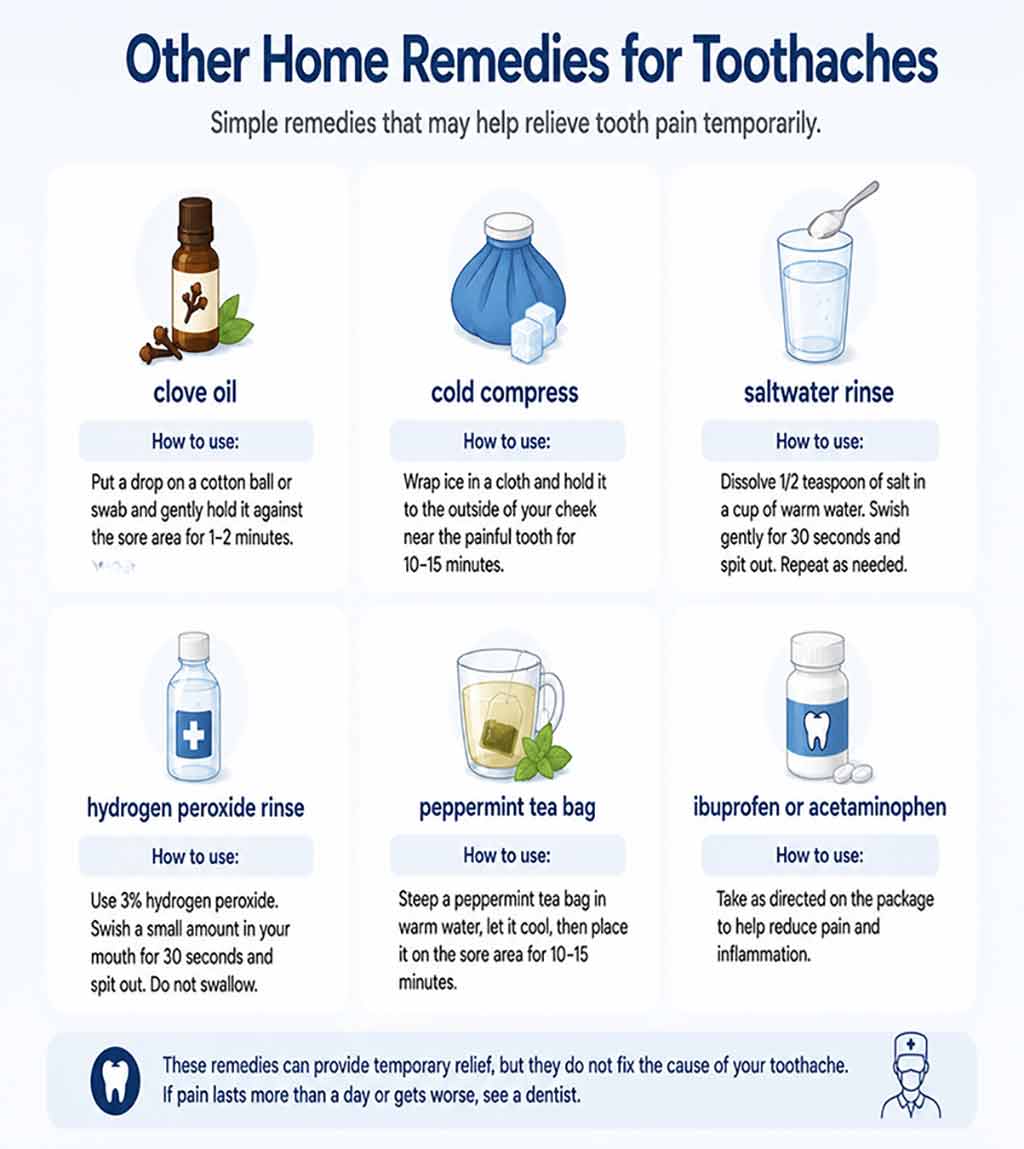
Clove oil, a cold compress, a saltwater rinse, and an over-the-counter pain reliever like ibuprofen or acetaminophen are other options people try.
For a fuller comparison, including hydrogen peroxide rinses and peppermint tea bags, see our guide on how long to leave garlic on a toothache.
When to Stop Home Remedies and Call a Dentist
A few signs mean it is time to stop using vanilla extract for tooth pain and call your dentist:
- Pain lasting more than a day or two
- Swelling in your face or gum
- A pimple or bump forming on the gum
- Pain that spreads to your ear, jaw, or neck
- Trouble swallowing or breathing
- A fever with the toothache
- A bad taste or pus in your mouth
- Pain bad enough to disrupt sleep or eating
If you notice trouble swallowing or breathing along with facial swelling, treat that as an emergency and seek care right away rather than waiting for a regular appointment.
Get Real Relief at My Dental & Implants
So can you use vanilla extract for a toothache? Yes, but a home remedy can buy you a little time. It will not fix what is actually wrong with your tooth. Finding that out takes a real exam.
At My Dental & Implants in Glendale, Dr. Nima Afzalian examines your tooth, takes an X-ray if needed, and gives you an honest plan, whether that means a filling, a root canal, or an extraction.
We offer same-day emergency visits for active pain, and we serve patients across Glendale, Peoria, and Phoenix with a focus on the least invasive option that fits your case.
Do not tough it out. Call My Dental & Implants at (623) 300-2550 to get seen at 6637 West Peoria Ave Suite D-2, Glendale, AZ 85302.
FAQs
What does vanilla extract do for a toothache?
Its alcohol can numb the surface of your gum for a few minutes, but it does not treat what is actually causing the pain.
Does vanilla extract kill a tooth nerve?
No. No research backs this claim. Any effect comes from mild, brief numbing from alcohol, not from killing a nerve.
Does vanilla extract numb a toothache?
It can give a brief, mild numbing feeling on the surface of your gum from its alcohol, but this fades fast and does not reach the nerve inside your tooth.
Is vanilla extract as effective as clove oil for tooth pain?
No. Clove oil’s effect comes from eugenol, a compound with real mild anesthetic properties. Vanilla’s flavor comes from vanillin, which has no such effect. Vanilla extract’s only real effect comes from its alcohol, so it works milder and shorter than clove oil.
Is vanilla extract good for a toothache?
It is not a treatment, but a small amount used carefully is a low-risk way to get brief relief while you wait to see a dentist.
Can children use vanilla extract for a toothache?
It is generally not safe for children, since the alcohol content is too strong for a child’s mouth.
Can I swallow vanilla extract for a toothache?
No more than a drop or two, given how much alcohol it contains.
How long does vanilla extract relieve tooth pain?
Only for a few minutes, and it does nothing for whatever is actually causing the pain.
Does vanilla extract's antioxidant content relieve tooth pain?
No. There is no evidence that vanillin or antioxidants help a toothache. The alcohol causes any relief, not the vanilla flavor itself.
Does the smell of vanilla extract help a toothache?
It may feel calming, but the smell alone does not numb or treat your tooth. Any real effect still comes from the alcohol on your gum.
Share this Article

Dr. Nima Afzalian's
Dr. Nima Afzalian's
journey in dentistry began at 12 when he experienced the transformative power of
dental care during a tooth-filling procedure. That pivotal moment ignited his passion for dentistry, and
he has since dedicated his life to making a difference in people's lives by relieving pain and
discomfort through his expertise.
Nima earned his bachelor's and master's degrees in Biomedical Engineering from the
prestigious Barrett
Honors College at Arizona State University. Subsequently, he obtained his dentistry doctorate
from the
Midwestern College of Dental
Medicine, graduating with honors, with recognition in Dental Implants and
the Dean's Award as the Top Clinician of his class.
With his extensive education, clinical excellence, and genuine dedication to patient well-being, Dr.
Nima Afzalian is excited to provide you with the highest level of care for all your dental needs. When
you choose Dr. Nima, your oral health is in capable hands!
Success Stories
We are blessed with clients and patients who are loyal to us and have the nicest things to say about us.
Translate »