
09
Nov
Dangers of One-Day Dental Implants and How to Lower Your Risk
Table of Contents
- Are One-Day Dental Implants Safe?
- Possible Dangers of One-Day Dental Implants
- 1. A slightly higher chance of implant failure
- 2. Movement during early healing
- 3. Infection and slow healing
- 4. Bone loss around the implant
- 5. Swelling, soreness, and a longer appointment
- Who Has a Higher Risk With Same-Day Implants?
- How to Lower the Risks of One-Day Implants
- Conclusion
The dangers of one-day dental implants include infection, slow healing, and the implant not joining with the bone. Still, many people do well with careful planning. “One-day” means you get an implant and replacement teeth in one visit.
Before treatment, your gums, jawbone, and health need to be checked. Ask whether your first teeth will be temporary and if the price includes your final teeth. In this guide, My Dental & Implants explains the risks, who may have more problems, and what can help your mouth heal.
Are One-Day Dental Implants Safe?
Yes, one-day dental implants can be safe for some people. But they are not right for everyone. Harvard School of Dental Medicine says your jawbone and health must be suitable. Getting an implant and replacement teeth on the same day also carries added risks.
The tooth extraction and implant timeline depends on your mouth. You may have a tooth removed and an implant placed in the same visit. Or you may need to let the area heal before the implant is placed.
With same-day treatment, replacement teeth are attached soon after implant placement. With traditional treatment, the implant heals before the teeth are attached. Both options still need planning visits and follow-up checks.
Possible Dangers of One-Day Dental Implants
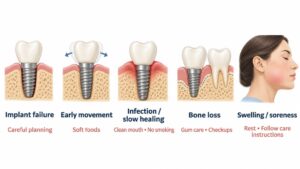
Not everyone has problems after treatment. Some risks can happen with any implant surgery. Others come from putting too much pressure on a new implant before it heals. The bone needs time to grow around the implant and hold it in place. Careful planning and proper care can help lower the risks.
Below, we explain the possible dangers of one-day dental implants and what may help prevent them:
| Possible risk | What it means in plain words | What may help lower it |
| Implant failure | The implant does not fuse with bone. | Careful patient selection and planning. |
| Early movement | Chewing puts pressure on the healing implant. | Follow food and chewing limits. |
| Infection and slow healing | Germs or health problems affect recovery. | Cleaning, no smoking, and follow-ups. |
| Bone loss | Bone around the implant shrinks. | Healthy gums and regular checkups. |
| Swelling and soreness | The treated area feels swollen or tender. | Rest and the dentist’s pain plan. |
1. A slightly higher chance of implant failure
Implant failure means the implant becomes loose or does not join firmly with the jawbone. It may need to be removed. A review of 37 clinical studies found that about 18 out of every 1,000 implants failed when replacement teeth were attached soon after surgery.
About 4 out of every 1,000 failed when the implant was left to heal before teeth were attached. Most implants stayed in place with both methods. These are study results, not a prediction of your own treatment.
2. Movement during early healing
With same-day implants, replacement teeth are attached before the implant has fully joined with the bone. Biting or chewing on these teeth can put pressure on the healing implant. Too much pressure may cause small movements that stop it from joining firmly with the bone.
If this happens, the implant may fail and need to be removed. Eating soft foods and following chewing instructions helps protect the implant while it heals.
3. Infection and slow healing
Infection can happen after implant surgery, including same-day treatment. Smoking and poorly controlled diabetes can affect healing and raise the chance of problems. Keep the area clean as directed and attend follow-ups. Same-day placement should not be assumed to raise or lower infection risk by itself.
4. Bone loss around the implant
Bone loss means there is less bone around the implant to hold it in place. If too much bone is lost, the implant may become loose. But same-day implants do not always cause more bone loss.
A 2015 review of 37 clinical studies found slightly less bone loss when replacement teeth were attached soon after implant placement than when they were attached after healing. Keeping your gums clean and having regular checkups can help catch problems early.
5. Swelling, soreness, and a longer appointment
Pain is a common concern, so you may wonder, “Does getting a dental implant hurt?” No, the area is numbed during surgery, but some soreness and swelling are common afterward. You will get instructions on how to ease discomfort and which symptoms to report.
Getting an implant and replacement teeth in the same visit may mean a longer appointment. Ask how much time to allow and plan to rest afterward.
Who Has a Higher Risk With Same-Day Implants?
Some health conditions and habits can make healing harder. Your gums and jawbone also need to support the implant. Here are some factors that may raise the risk of problems with same-day implants.
- Smoking after dental implant can slow healing and increase the chance of implant problems.
- Diabetes and other long-term illnesses may slow recovery, especially when poorly controlled.
- Gum disease can damage the gums and bone supporting the implant.
- Too little jawbone may make it hard to hold the implant firmly.
- Teeth grinding puts extra pressure on the implant and replacement teeth.
The FDA lists several of these factors as implant concerns. Healthy gums, enough bone, and good daily care help make treatment suitable. Overall health matters more than age. If you need a bone graft or more healing time, a slower plan may be a better choice
How to Lower the Risks of One-Day Implants
Careful planning and daily care can help lower the risks of one-day implants. Your mouth still needs time to heal, even if you get replacement teeth right away. Here are some steps that can help protect your implant.
- Ask about a 3D scan to check your jawbone and plan implant placement, as recommended by the American Dental Association.
- Eat soft foods and follow instructions about chewing.
- Avoid smoking before treatment and while healing.
- Clean your mouth daily and follow brushing instructions for the healing area.
- Attend follow-up visits to check healing and make sure the implant stays firm.
- Get a written plan showing the treatment steps, temporary teeth, final teeth, and full cost.
The implant may need several months to join with the bone, according to the ADA. Contact the dental team right away if you notice any of these signs.
- Fever
- Swelling or pain that gets worse
- Bleeding that does not stop
- A loose implant or replacement tooth
Conclusion
The dangers of one-day dental implants deserve careful discussion. Planning, suitable bone support, and good aftercare can help lower risk. Before deciding, ask why a same-day or staged plan suits your mouth. To discuss implant options, schedule an implant consultation in Glendale with My Dental & Implants at (623) 300-2550.
FAQs
1. Do one-day dental implants fail more often than traditional implants?
A review found higher failure risk with immediate loading, although both approaches had high implant survival.
2. Can you get a dental implant the same day as extraction?
Yes, an implant can sometimes be placed immediately after extraction, depending on bone support, gum health, and your dentist’s assessment.
3. Does "one day" mean I only need one visit?
No. You still need an assessment, planning, follow-ups, and possibly another visit for final teeth.
4. Are the teeth I get on the same day permanent?
Often, they are temporary. Ask which teeth you will receive and when the final set will be fitted.
5. Who is good candidate for same-day implants?
People with limited bone, untreated gum disease, healing problems, or heavy grinding may need another approach.
6. What should I do after same-day implant surgery to protect healing?
Follow your dentist’s food, cleaning, smoking, and chewing instructions. Keep follow-up visits and report problems promptly.
Share this Article

Dr. Nima Afzalian's
Dr. Nima Afzalian's
journey in dentistry began at 12 when he experienced the transformative power of
dental care during a tooth-filling procedure. That pivotal moment ignited his passion for dentistry, and
he has since dedicated his life to making a difference in people's lives by relieving pain and
discomfort through his expertise.
Nima earned his bachelor's and master's degrees in Biomedical Engineering from the
prestigious Barrett
Honors College at Arizona State University. Subsequently, he obtained his dentistry doctorate
from the
Midwestern College of Dental
Medicine, graduating with honors, with recognition in Dental Implants and
the Dean's Award as the Top Clinician of his class.
With his extensive education, clinical excellence, and genuine dedication to patient well-being, Dr.
Nima Afzalian is excited to provide you with the highest level of care for all your dental needs. When
you choose Dr. Nima, your oral health is in capable hands!
Success Stories
We are blessed with clients and patients who are loyal to us and have the nicest things to say about us.
Translate »