

20
Aug
Does Lemonade Stain Your Teeth?
You just whitened your teeth, got veneers, or had a crown placed, and now you wonder if your daily lemonade habit is quietly working against that fresh smile. So you Google: Does lemonade stain your teeth?
The plain answer is no, not the way coffee, tea, or red wine do, since lemonade does not carry strong pigment. What it does do is soften and roughen your enamel through its citric acid, a process dentists call erosion, and that rougher surface can pick up stains from other foods and drinks more easily afterward.
Is Lemonade Bad for Your Teeth and Dental Health?
Yes, lemonade can hurt your teeth, but it does not stain your teeth. What it does is erode them, since its acid softens and wears down the enamel surface over time.
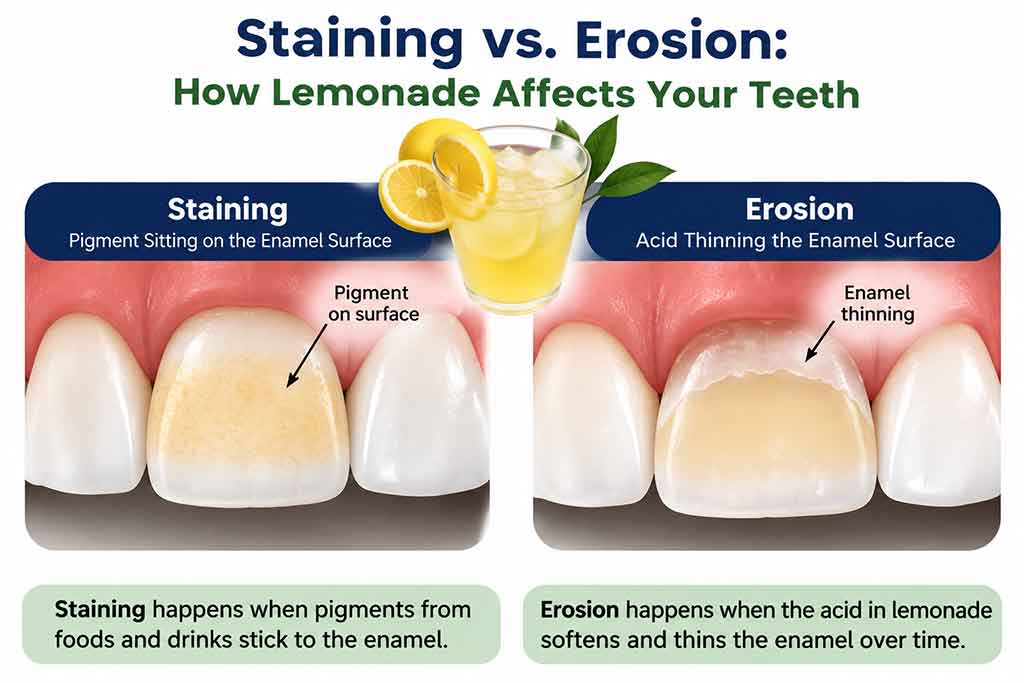
Staining and erosion are two different problems. Staining means pigment from dark foods and drinks sticks to your enamel. Erosion means acid softens and wears down the enamel surface itself. One study found lemon juice caused roughly 4 times more enamel loss than regular cola, and about 6 times more than diet cola, over the same time period, so the real risk with lemonade is bigger than most people assume, just not the risk they expect (Zimmer S, Kirchner G, Bizhang M, Benedix M, “Influence of Various Acidic Beverages on Tooth Erosion. Evaluation by a New Method,” PLOS ONE, 2015).
Lemonade sits at a pH of roughly 2 to 3. Your enamel starts to soften and lose minerals once the pH around your teeth drops below about 5.5, the point dentists call the critical pH (American Dental Association Health Policy Institute, “Information Sheet on pH of Home Oral Care Products”).
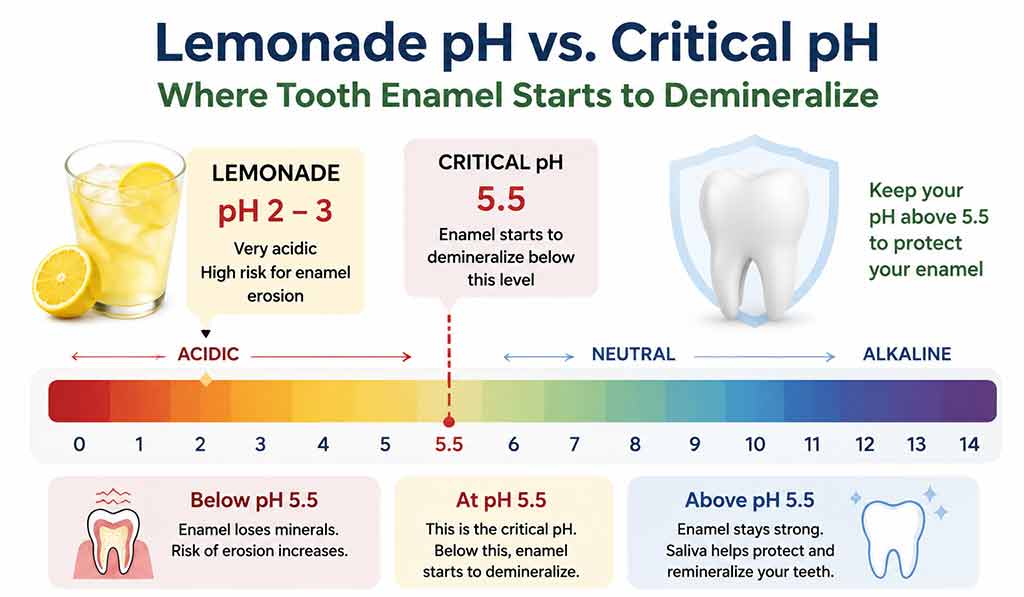
Here is what that acid actually does to your enamel over time:
- Softens the outer layer of enamel right after you drink it, before saliva can neutralize the acid.
- Thins the enamel over time, so more of the natural yellow layer underneath, called dentin, starts to show through, which makes the tooth look more yellow instead of truly stained.
- Roughens the enamel at a very small scale, so pigment from other foods grips on more easily.
- Raises sensitivity to hot, cold, or sweet food once enough enamel wears thin.
Sugar adds a second problem. It feeds the bacteria in plaque, and those bacteria make their own acid, which raises your risk of cavities and decay. Sugar-free or diet lemonade skips that sugar risk, but the acid stays, so it still wears down enamel.
Lemon water carries the same acid, so it erodes enamel the same way, even without sugar. Any brighter look after lemon water is just surface residue coming off, not real whitening, and regular use thins enamel and leaves teeth duller instead.
Is Lemonade Worse for Your Teeth Than Soda?
The difference between lemonade and soda for teeth depends on which kind of damage you mean. The table below lays out real, measured numbers.
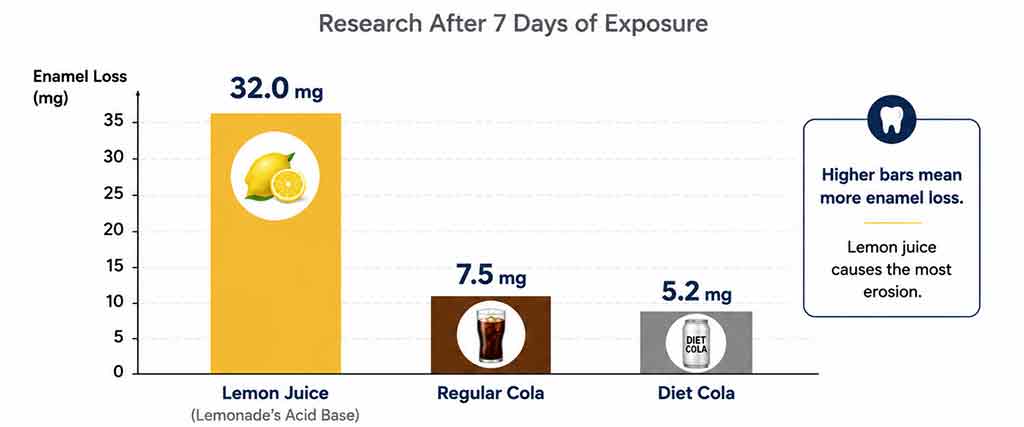
| Drink | Main effect |
| Lemon juice (lemonade’s acid base) | Erosion, with very little staining |
| Regular cola | Less erosion, some staining from color |
| Diet cola | Least erosion, some staining |
Lemonade wears down enamel more than soda, but dark soda leaves more surface stain. Neither one wins outright. They damage teeth in different ways, and both stay safer in moderation with the habits below.
Does Lemon Make Your Teeth Yellow?
Lemon does not put yellow color onto your teeth. Its acid thins your outer enamel over time, and enamel is naturally see-through, so the more it thins, the more the yellow dentin layer underneath shows through. Your teeth look yellower, but nothing sits on top of them the way a real stain does. The color change comes from thinner enamel, not a coating.
Does Lemonade Stain or Affect Porcelain Veneers and Crowns?
So do veneers stain from lemonade? In general, no. Lemonade does not stain porcelain veneers or crowns, and it does not wear them down the way it wears down natural enamel. Porcelain is a hard, glazed material, so lemonade’s acid mostly leaves it alone.
Here is what that means for your smile:
- Porcelain resists stains and acid far better than natural tooth enamel.
- Color changes are more likely at the edges, where the porcelain meets your natural tooth, or on the natural teeth and gums nearby.
- An old veneer or crown with worn glaze can pick up stains at those edges over time, even though the porcelain itself holds up fine.
You do not need to avoid lemonade just because you have veneers or crowns. Rinse with water afterward to protect the edges and the teeth nearby, and let your dentist check the glaze at your regular visit.
How to Enjoy Lemonade Without Damaging Your Teeth
A few small habits protect your enamel without giving up lemonade (American Dental Association, MouthHealthy, “Dietary Acids and Your Teeth”):
- Drink it in one sitting. Do not stretch it out across the whole day, since that keeps acid on your teeth longer.
- Use a straw to keep it off your front teeth.
- Rinse with plain water right after. Do not brush right away.
- Wait about an hour before you brush, since brushing too soon can spread the softened enamel.
- Pair it with cheese, milk, or another calcium-rich food to help neutralize the acid.
- Keep a fluoride toothpaste or a fluoride mouthwash in your normal routine.
Saliva works with fluoride, from toothpaste or a mouthwash, to remineralize enamel. That means fluoride helps re-harden enamel that acid has softened, which is why occasional exposure with good habits tends to be manageable, even though frequent acid exposure over time can still wear enamel down.
Is There a Way to Get Lemonade Stains Off Your Teeth?
Not really, since lemonade rarely leaves a deep stain on its own. Dullness after drinking a lot of it usually comes from other foods that stick to the rougher enamel lemonade leaves behind, not from the lemonade itself.
A few real methods clear up that surface buildup:
- Brush twice a day with a soft-bristle brush and a fluoride toothpaste to lift buildup before it sets in.
- Floss daily so buildup does not collect between teeth, where a brush cannot reach.
- Book a regular cleaning so a hygienist can clear buildup a toothbrush cannot touch.
- Skip the urge to scrub with more lemon or baking soda to whiten your teeth, since both wear down enamel instead of clearing a real stain.
If your teeth stay dull or yellow after a normal cleaning, that points to thin enamel rather than a stain, and a whitening consult is the better next step.
When to See a Dentist About Enamel Erosion
A few signs point to enamel wear that a checkup should look at:
- Teeth that look dull or slightly yellow even with normal brushing
- New or growing sensitivity to cold, hot, or sweet food
- Front teeth that look rounded or glassy at the edges
- Visible dullness that a regular cleaning does not clear up
Protect Your Smile at My Dental & Implants
Does lemonade stain your teeth? Lemonade in moderation, with a few smart habits, is not something you need to give up for your teeth or your veneers and crowns. The real value comes from catching enamel wear early, before it turns into sensitivity or a bigger repair.
At My Dental & Implants in Glendale, Dr. Nima Afzalian checks your enamel for wear and surface stains at every regular visit, and gives you an honest read on whether a cleaning or a whitening consult fits your case. If you have veneers or crowns, he checks the glaze and the edges too, and our team also serves patients across Peoria and Phoenix. We lean toward the least invasive option that protects what you already have, natural or restored, instead of pushing treatment you do not need.
Call My Dental & Implants at (623) 300-2550 to set up a visit at 6637 West Peoria Ave Suite D-2, Glendale, AZ 85302, and get a clear answer for your own smile.
FAQs
Does the acid in lemonade damage teeth?
Yes. The citric acid softens and slowly wears down your outer enamel. That is erosion, and it is the main real risk with lemonade.
Does drinking lemonade all day affect dental health?
Yes, more than the same amount in one sitting. If you sip it across the day, acid stays on your teeth longer, and your enamel gets less time to recover.
Does soda stain your teeth?
Dark soda carries more staining pigment than lemonade, but lemonade wears down enamel more. They damage teeth in different ways rather than one being simply worse.
Does Coke stain your teeth?
Yes, a little. Its caramel color leaves some surface stain, though it erodes enamel less than lemonade does.
Is lemon water bad for your teeth?
It carries the same acid as lemonade without the sugar, so it erodes enamel the same way. The missing sugar lowers your cavity risk, not your erosion risk.
How long after drinking lemonade should I brush my teeth?
Wait about an hour. Brushing right after an acidic drink can spread the softened enamel instead of protecting it.
Does lemonade cause cavities?
The acid causes erosion, but sugar is the bigger cavity risk, since it feeds the bacteria that make decay-causing acid. Sugar-free lemonade removes that cavity risk but still erodes enamel the same way.
Is fruit juice as bad for teeth as lemonade?
Most fruit juice carries a similar acid and a low pH, so it erodes enamel about the same way. Sweetened juice adds the same cavity risk as regular lemonade.
What drinks stain teeth more than lemonade?
Coffee, black tea, red wine, and cola stain more, since they carry more pigment. Lemonade’s main effect is erosion, not staining.
Is fruit juice as bad for teeth as lemonade?
Most fruit juice carries a similar acid and a low pH, so it erodes enamel about the same way. Sweetened juice adds the same cavity risk as regular lemonade.
Share this Article

Dr. Nima Afzalian's
Dr. Nima Afzalian's
journey in dentistry began at 12 when he experienced the transformative power of
dental care during a tooth-filling procedure. That pivotal moment ignited his passion for dentistry, and
he has since dedicated his life to making a difference in people's lives by relieving pain and
discomfort through his expertise.
Nima earned his bachelor's and master's degrees in Biomedical Engineering from the
prestigious Barrett
Honors College at Arizona State University. Subsequently, he obtained his dentistry doctorate
from the
Midwestern College of Dental
Medicine, graduating with honors, with recognition in Dental Implants and
the Dean's Award as the Top Clinician of his class.
With his extensive education, clinical excellence, and genuine dedication to patient well-being, Dr.
Nima Afzalian is excited to provide you with the highest level of care for all your dental needs. When
you choose Dr. Nima, your oral health is in capable hands!
Success Stories
We are blessed with clients and patients who are loyal to us and have the nicest things to say about us.
Translate »