

05
May
Why Are My Teeth Cracking All of a Sudden?
If you just felt a rough edge with your tongue, saw a new line in a tooth, or had a piece come off while you were eating, you are probably asking yourself: “Why are my teeth cracking all of a sudden?” or “Why are my teeth breaking all of a sudden?”, and how worried you should be.
Not every crack is the same, and not every crack is equally urgent. Tooth cracking or breaking mainly happens because of too much force on the tooth or enamel that’s been worn down over time. Knowing the reason makes it easier to find the suitable treatment.
This guide starts by helping you figure out why a cracked or broken tooth happens. If you are in pain right now, you can skip ahead to the emergency-signs section below.
Why Are My Teeth Cracking? Causes of Cracked Teeth
The cause usually comes down to more force or more wear than a tooth can handle, and it builds up in a few different ways. The same forces behind cracking are often behind why teeth chip or break, too.
But let’s dig deeper and answer the question “Why do teeth crack?” in better details:
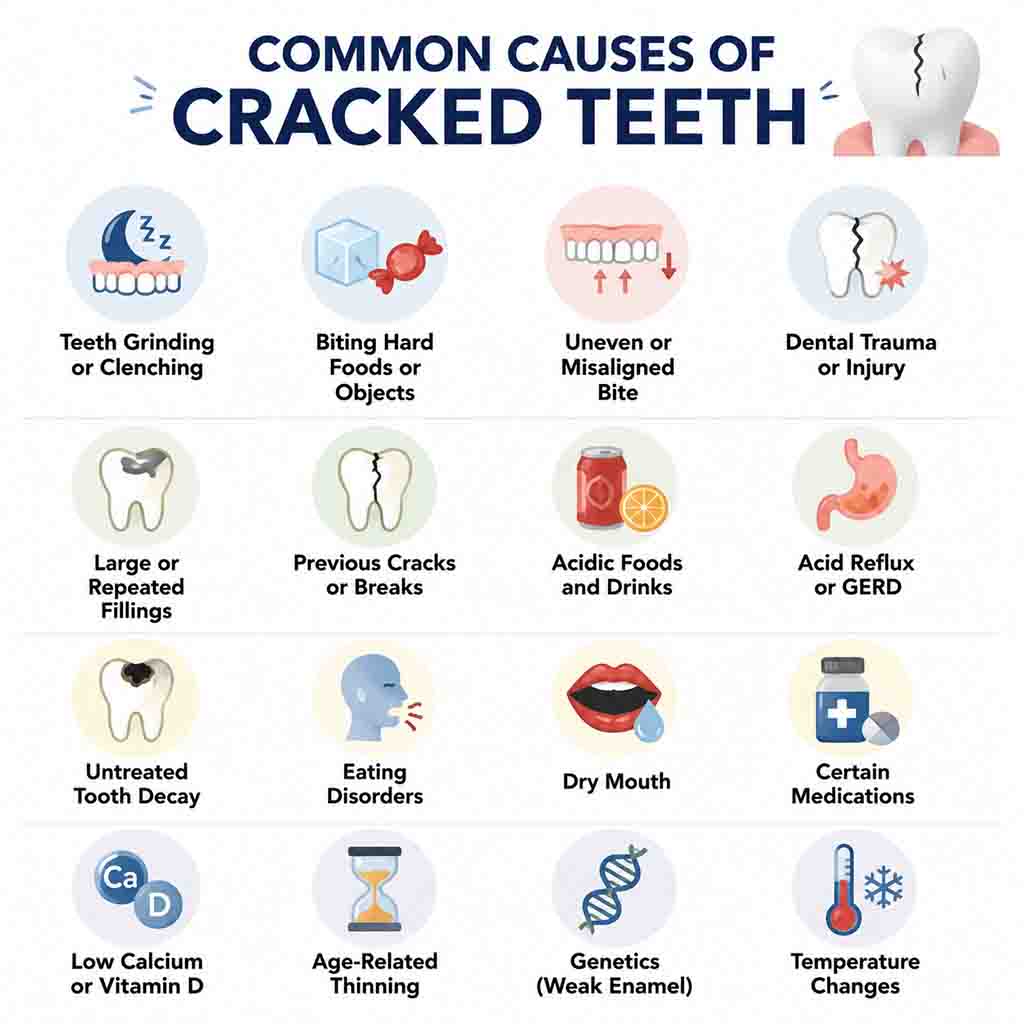
Habits and Bite Force
- Grinding or Clenching: Also called bruxism. Repeated pressure, especially at night, wears down and stresses the tooth until a crack forms.
- Hard Foods and Objects: Biting into ice, pens, or hard candy applies a sudden, concentrated force the tooth isn’t built to absorb in one spot.
- Uneven or Misaligned Bite: When your teeth don’t meet evenly, certain teeth take more than their share of force with every bite, which weakens them over time.
- Trauma or Injury: A blow from a fall, a sports injury, or an accident delivers that same force-overload in a single moment instead of gradually.
Dental History
- Large or Repeated Fillings: Each filling removes some natural tooth structure, so the remaining tooth has less material to absorb everyday chewing force. Metal amalgam fillings add to this, since they expand and contract with hot and cold more than natural tooth structure, which stresses the tooth around them over time.
- Past Cracks or Breaks: A tooth that has already cracked has a weak point that concentrates stress the next time you bite down, making a repeat crack more likely in the same spot.
Diet and Acid
- Acidic and Sugary Foods: Acid softens and wears away enamel with repeated exposure, and enamel doesn’t grow back, so the tooth becomes more brittle over time.
- Acid Reflux or GERD: Stomach acid reaching your mouth erodes enamel from the inside the same way acidic food does from the outside.
- Untreated Tooth Decay: Decay eats into the tooth structure, leaving a weaker, hollowed-out area that’s more likely to give way under normal biting pressure.
- Eating Disorders: Frequent vomiting exposes teeth to stomach acid in the same way reflux does, wearing enamel down from repeated contact.
Health and Medication
- Dry Mouth: Saliva neutralizes acid and washes away food particles, so less of it means more acid exposure and faster enamel wear.
- Certain Medications: Some reduce saliva production, which has the same drying effect, and others affect bone and tooth density directly, making teeth more brittle.
- Low Calcium or Vitamin D: These nutrients help build and maintain tooth mineral density, so a shortage can leave teeth structurally weaker.
None of these are meant as a self-diagnosis. They are simply worth mentioning at your next visit so your dentist has the full picture.
Age and Wear
- Age-Related Thinning: Enamel wears thinner with decades of normal use, leaving less of a protective layer to absorb daily bite force.
- Genetics: Some people are born with thinner or softer enamel, which gives them less of a buffer against the same everyday forces that other teeth handle fine.
- Temperature Changes: Enamel expands and contracts slightly with hot and cold. Repeating that swing, like going from coffee to ice water, adds tiny amounts of stress that accumulate over years.
Is a Cracked Tooth an Emergency?
Not every cracked tooth needs same-day care, but some do, so here is a direct way to tell the difference.
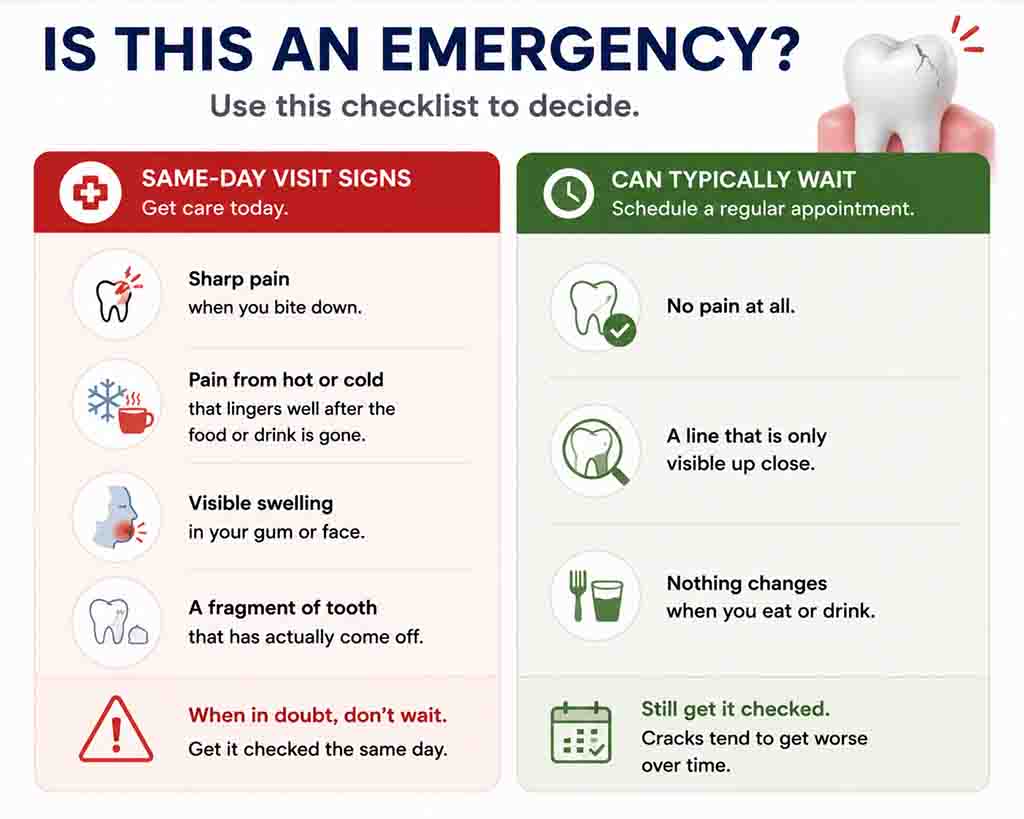
A crack that’s already there tends to get worse rather than stay the same, especially on a molar or premolar, so it’s worth booking a regular visit rather than waiting it out indefinitely.
Craze Lines vs Cracked Tooth
A craze line is a thin, shallow crack in the outer layer of enamel. It’s one of the most common reasons someone notices a line with no other symptoms, since it usually causes no pain at all. A cracked tooth or a fractured cusp is more likely to come with the sharp-pain-on-biting pattern described above. Only an in-person exam can tell you for certain which one you have.
What Should I Do If I Think I Have a Cracked Tooth?
While you wait for your appointment, there are a few simple things you can do:
- Rinse your mouth with warm water to clean the area.
- Avoid chewing on that side of your mouth.
- If a piece of the tooth comes off, save it and bring it with you.
- Use a cold compress on your cheek if there is any swelling.
- Do not place aspirin directly on the gum or tooth, since this can irritate the tissue and does not help the tooth itself.
These steps are first aid, not treatment. They are meant to keep you comfortable and protect the tooth until your dentist can see you, not to fix the underlying crack.
Can a Cracked Tooth Be Fixed?
Whether a cracked tooth can be fixed, and how, depends entirely on the type and depth of the crack, which is something only an exam can determine.
- A minor chip or a shallow crack is often treated with bonding or a tooth-colored filling.
- A fractured cusp is often treated with a dental crown, which covers and protects the weakened tooth.
- If the crack reaches the nerve inside the tooth, a root canal may be needed to save it.
- If the crack has gone too deep, such as with a split tooth or a crack that extends into the root, the tooth sometimes cannot be saved as a whole tooth, and a dental extraction with a replacement option, like a dental implant, may be the more realistic path forward.
No treatment, including bonding, a crown, or a root canal, can be guaranteed to work perfectly, be pain-free, or last forever, and your dentist can walk you through realistic expectations for your specific case once they have seen the tooth.
Can You Prevent Sudden Cracking?
While you cannot prevent every crack, a few habits meaningfully lower your risk. Here are some prevention tips for sudden tooth cracking:
- Wear a night guard if you grind or clench your teeth while sleeping.
- Wear a mouthguard during sports or other activities where your mouth could take a hit.
- Avoid chewing ice, hard candy, or using your teeth to open packages.
- Treat cavities early, before they weaken the tooth further.
- Keep up with regular dental cleanings, which give your dentist a chance to catch small problems, like an old filling under strain, before they turn into a crack.
What to Do Next
So why are my teeth cracking? Most of the time, a cracked tooth comes down to one of two things: too much force on the tooth, or enamel that’s worn down over time. Knowing which type of crack you’re dealing with, and how urgent it is, is what decides your next step.
If you think you have a cracked tooth, the safest first step is simply getting it looked at, since guessing which type it is from home only goes so far.
My Dental & Implants helps Glendale-area patients figure out whether a cracked tooth needs attention today or can wait for a regular visit, and we do our best to see emergency cases the same day when something feels urgent.
Dr. Nima Afzalian and his team can examine the tooth, confirm what you are actually dealing with, and walk you through the right next step, whether that is a simple filling, a crown, or something more involved.
If you are not sure what you are looking at, call our Glendale office at (623) 300-2550 and describe it to our team before deciding what to do next.
FAQs
Why are my front teeth cracking?
Usually a craze line, from biting into hard foods, grinding, or an old injury. It’s typically painless. A dentist can confirm what you’re seeing.
Why are my teeth breaking?
What causes teeth to break usually includes an existing weak spot, from an old filling, decay, or a previous crack, finally giving way, often triggered by something as simple as biting into hard food.
How do I know if a cracked tooth needs to be pulled?
Only an exam can tell you for certain. A tooth usually needs to come out when the crack has split it or reached deep into the root.
Why are my teeth cracking and breaking off?
This usually means the tooth was already weakened by an old filling, decay, or a previous crack, and a new crack finished the job.
How do I get my teeth to stop cracking?
Wear a night guard if you grind. Avoid hard foods and objects, treat cavities early, and keep up with regular checkups.
Can a cracked tooth heal on its own?
No. A very shallow craze line may not need treatment beyond monitoring, but anything more needs a dentist’s care.
Can a vitamin or mineral deficiency cause my teeth to crack?
Yes, low calcium or vitamin D can weaken tooth strength over time. It’s one factor among several, not a stand-alone diagnosis.
Can stress cause my teeth to crack?
Indirectly. Stress is a common trigger for grinding and clenching, and that added force leads to cracks over time.
What does a cracked tooth actually feel like?
Often sharp pain when you bite down, or lingering discomfort from hot or cold. Craze lines usually cause no feeling at all.
What illness causes teeth to break?
Acid reflux or GERD can wear down enamel from the inside. Certain medications and conditions that cause dry mouth can play a role too.
At what age do teeth start cracking?
No single age. It depends more on habits, dental history, and enamel wear, though cracks do become more common as people get older.
Share this Article

Dr. Nima Afzalian's
Dr. Nima Afzalian's
journey in dentistry began at 12 when he experienced the transformative power of
dental care during a tooth-filling procedure. That pivotal moment ignited his passion for dentistry, and
he has since dedicated his life to making a difference in people's lives by relieving pain and
discomfort through his expertise.
Nima earned his bachelor's and master's degrees in Biomedical Engineering from the
prestigious Barrett
Honors College at Arizona State University. Subsequently, he obtained his dentistry doctorate
from the
Midwestern College of Dental
Medicine, graduating with honors, with recognition in Dental Implants and
the Dean's Award as the Top Clinician of his class.
With his extensive education, clinical excellence, and genuine dedication to patient well-being, Dr.
Nima Afzalian is excited to provide you with the highest level of care for all your dental needs. When
you choose Dr. Nima, your oral health is in capable hands!
Success Stories
We are blessed with clients and patients who are loyal to us and have the nicest things to say about us.
Translate »