
18
Nov
How Long After a Bone Graft Can I Get an Implant?
Table of Contents
Patients often ask us, “How long after a bone graft can I get an implant?” Most people wait at least three months, and some wait closer to a year. The bone graft healing time depends on the type of graft and on how your jaw heals, so each person’s wait is a little different.
Planning a dental implant after bone graft surgery takes patience, but each step has a reason. In this guide, My Dental & Implants explains why grafts are needed, how long each type takes to heal, what can change the wait, and what happens if you wait too long.
Quick Overview
Here is a quick look at the dental bone graft recovery timeline. According to Cleveland Clinic and Mayo Clinic, the timing generally follows this order, and your dentist will set the exact timing for you.
| Stage | Usual timing | What is happening |
| Early healing | About 1 week | The area settles after surgery |
| Bone growth | At least 3 months, and 9 to 12 months for a large graft | New bone grows in and firms up |
| Bone check | When healing is done | Your dentist uses an exam and imaging to confirm there is enough bone |
| Implant placement | Ideally within 6 to 12 months after healing | The implant goes in while the bone is still strong |
Why Do Some Dental Implants Require a Bone Graft?
An implant works like a tooth root. It has to stay firm while you chew, and chewing puts strong pressure on the jaw. If the jawbone is too thin or too soft, the implant may not hold. According to Mayo Clinic, a graft can create a more solid base.
A dental implant needs enough bone to stay steady when you chew. If you’ve lost bone, a graft can give the implant a firmer base. Mayo Clinic
Here are four reasons you might need a bone graft and how it can help:
- After a tooth extraction, a graft can limit bone loss around the empty socket.
- If gum disease has worn away bone, a graft can rebuild the area where the implant will go.
- If a jaw injury left a gap in the bone, a graft can help fill it.
- If your jawbone has thinned after years of wearing dentures, a graft can build up the thin areas.
Not everyone needs a graft. Our post on dental implants with bone loss covers each option, including a bone graft for dental implants.
How Long Each Bone Graft Type Takes to Heal Before Dental Implants
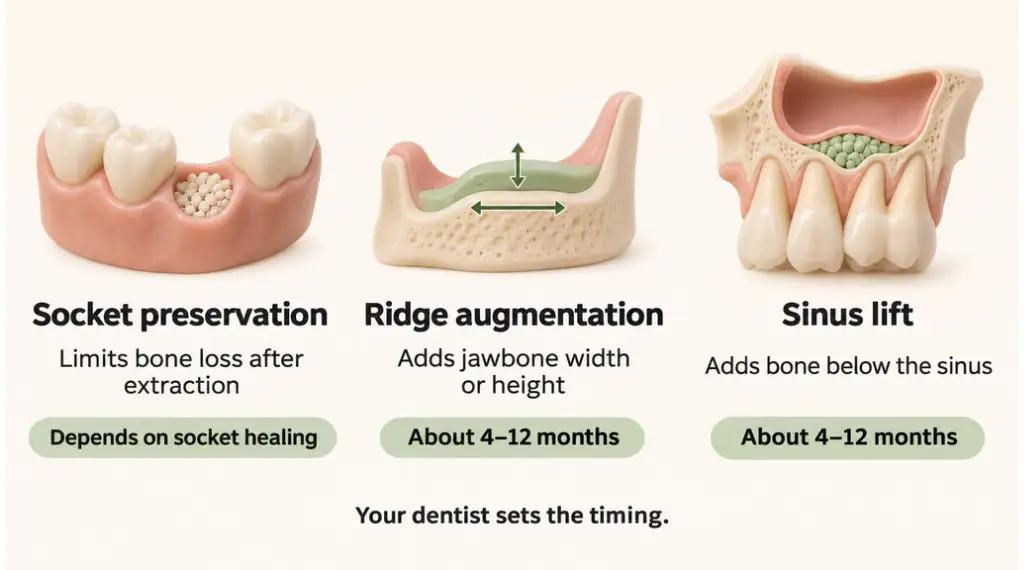
There are a few types of bone grafts for dental implants, and the dental bone graft healing time depends on which one you have. The table shows the usual bone graft healing time before dental implant placement. All times are approximate, and your dentist sets the timing for you.
| Bone graft type | What it does | Usual wait before an implant |
| Socket preservation | Helps limit bone loss after a tooth is removed | Depends on how the socket heals |
| Ridge augmentation | Adds width or height to the jawbone | About 4 to 12 months |
| Sinus lift | Adds bone below the sinus in the upper back jaw | About 4 to 12 months |
Socket Preservation
Your dentist places graft material in the empty socket right after removing a tooth. The bone around that socket can shrink as it heals. A graft helps preserve the bone so there’s more support for a future implant. At your follow-up, your dentist checks the area and decides when there’s enough bone to place the implant.
Ridge Augmentation
The ridge is the part of your jawbone that holds your teeth. If it’s too narrow or too short where a tooth is missing, a graft can build it up to support an implant. The graft gives new bone time to grow in that area. Implant placement usually follows after about 4 to 12 months of healing, according to the American Academy of Periodontology.
Sinus lift
A sinus lift builds up bone beneath the sinus so it can support a dental implant in the upper back jaw. According to the American Academy of Periodontology, the bone usually needs about 4 to 12 months to heal before an implant can be placed.
Factors That Affect Bone Graft Healing Time
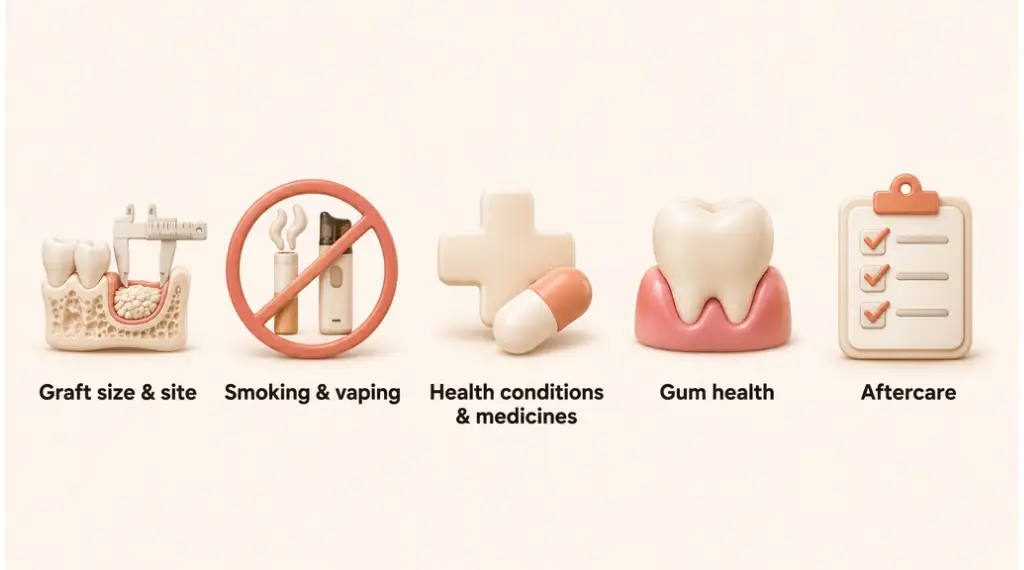
Dental bone graft healing time depends on the size and location of the graft, your health, and how you care for the area. Here are five factors that can affect how your bone graft heals and what you can do about each one:
| Factor | What you can do |
| Graft size and site | Ask your dentist what to expect. |
| Smoking and vaping | Do not smoke or vape. Cleveland Clinic says failure is more likely in smokers. |
| Health conditions and medicines | Tell your dentist about both. |
| Gum health | Treat gum disease first and keep your gums clean. |
| Aftercare | Follow your dentist’s steps. |
Risks of Waiting Too Long for an Implant After a Bone Graft
A bone graft needs time to heal before it can support an implant. New bone can take several months to grow, according to Mayo Clinic. There is no strict maximum time between a bone graft and a dental implant, but Cleveland Clinic says the best window is within 6 to 12 months after the graft heals.
Here are a few things that can happen if you wait longer:
- The grafted bone may shrink or lose density.
- If too much bone is lost, you may need another graft, which can add time to your treatment.
- Nearby teeth may shift into the gap and change how your teeth fit together when you bite.
If more time has passed, your dentist can check whether there’s still enough bone to place the implant. If your implant is already in place and you’re waiting for the crown, read our guide on how long you can have an implant without a crown.
How Long Does a Bone Graft Last Without an Implant?
A healed bone graft can last a lifetime, but it needs an implant to stay strong. Cleveland Clinic explains that a graft with no implant can slowly shrink and get weaker. That is why you should get your implant within 6 to 12 months after the graft heals.
Acting on time also helps you prepare, because the whole process from graft to crown takes many months, says Mayo Clinic. Your dentist will give you dates for each step, so you can plan time off and payments.
Let’s Recap
How long to wait for an implant after a bone graft depends on the type of graft you have and how well it heals. Your dentist will check the grafted area to see whether it has enough bone to hold the implant. If you’re still planning treatment, ask whether the graft and implant can be done at the same visit and what you can do to help the area heal.
At My Dental & Implants in Glendale, we’ll check your jawbone, explain your options, and help you plan your new smile. Make an appointment today to find out if your bone graft is ready for a dental implant and plan your next step.
FAQs
1. How long after a bone graft can I get an implant if I had a sinus lift?
Often about four to 12 months, says the American Academy of Periodontology. Your dentist sets the exact time.
2. Can you do bone graft and implant at the same time?
Sometimes. A minor graft can be done at the same visit. Mayo Clinic says your jawbone condition decides this.
3. What if my graft has healed and I have not booked the implant yet?
Book a visit soon. Cleveland Clinic says it is ideal to place the implant within six to 12 months after healing.
4. How does my dentist know the graft is ready for an implant?
Your dentist uses an exam and imaging to check the bone. The calendar alone does not decide.
5. What are the signs that a bone graft is not healing well?
Cleveland Clinic lists pain or swelling that worsens after the first week, pus, gum recession, and no gain in bone. Call your dentist if you see these.
6. How long does a bone graft take to set?
Early healing takes about a week. The bone needs at least three months, and a large graft may need nine to 12, says Cleveland Clinic.
7. How much does a bone graft before an implant cost?
It depends on the graft type, the site, and your plan. Ask the office for a written estimate.
8. Will my dental plan help pay for a bone graft?
It depends on your plan and the reason for the graft. Ask the office to check your benefits. See our insurance and membership page.
Share this Article

Dr. Nima Afzalian's
Dr. Nima Afzalian's
journey in dentistry began at 12 when he experienced the transformative power of
dental care during a tooth-filling procedure. That pivotal moment ignited his passion for dentistry, and
he has since dedicated his life to making a difference in people's lives by relieving pain and
discomfort through his expertise.
Nima earned his bachelor's and master's degrees in Biomedical Engineering from the
prestigious Barrett
Honors College at Arizona State University. Subsequently, he obtained his dentistry doctorate
from the
Midwestern College of Dental
Medicine, graduating with honors, with recognition in Dental Implants and
the Dean's Award as the Top Clinician of his class.
With his extensive education, clinical excellence, and genuine dedication to patient well-being, Dr.
Nima Afzalian is excited to provide you with the highest level of care for all your dental needs. When
you choose Dr. Nima, your oral health is in capable hands!
Success Stories
We are blessed with clients and patients who are loyal to us and have the nicest things to say about us.
Translate »