
29
May
What Are Healing Caps in Dental Implants?
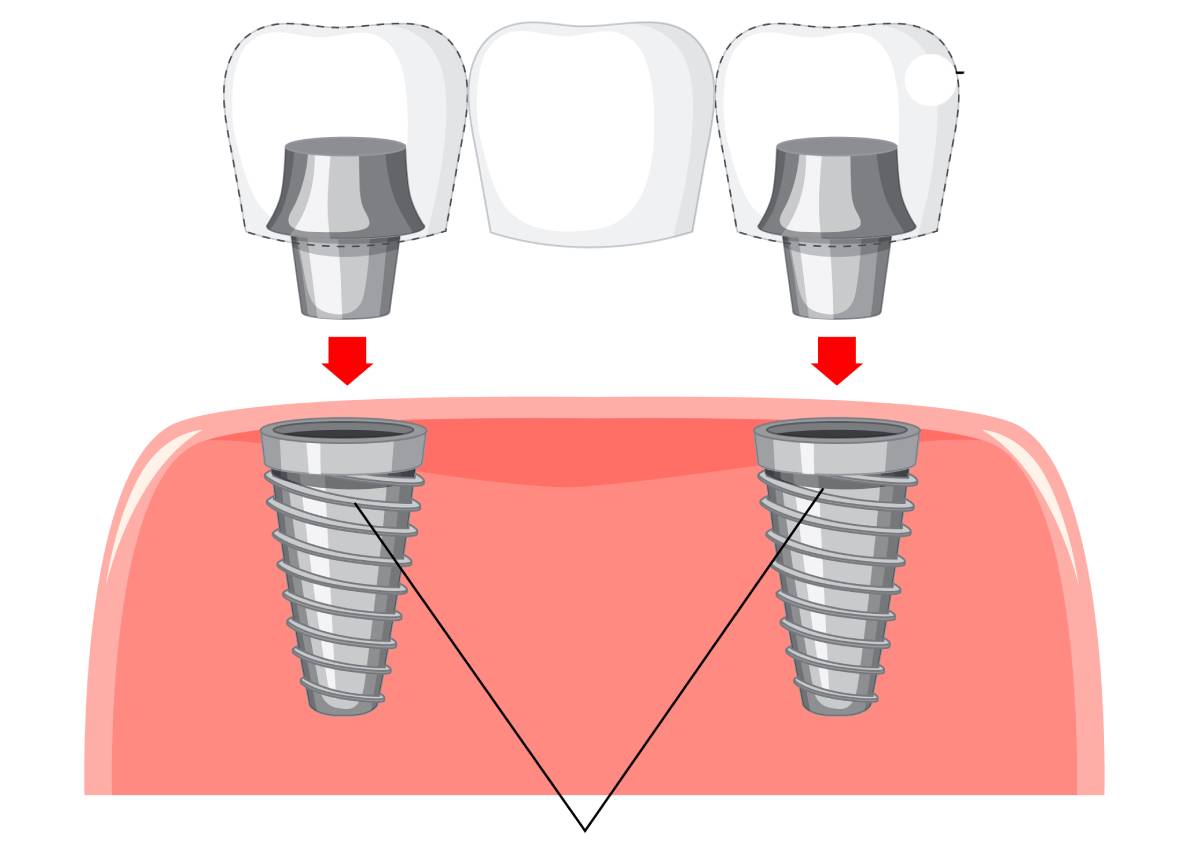
You just had implant surgery, and you noticed a small, dome-shaped piece sitting in the gum where the missing tooth used to be. Dentists call this an implant healing cap. It is a small cover that sits on top of the implant, and it protects the site and shapes the gum while everything heals.
This guide explains why your dentist placed one, how long a dental implant cap usually stays in place, and what counts as normal while your gum heals around it.
What is a Healing Cap on a Dental Implant (Healing Abutment)?
A healing cap for implants and a healing abutment are two names for the same small part. Right after your implant goes in, or shortly after, your dentist attaches this piece over the top of the implant post, where it sits above the gumline instead of buried underneath.
A healing cap tooth implant does a few main jobs while your mouth heals:
- It helps keep bacteria away from the tissue around the implant while bone grows onto it below the surface.
- It guides the gum into a smooth, even shape around the implant instead of over it, for a natural-looking result once your crown goes in.
- It helps keep food, plaque, and bacteria away from the surgical site during the weeks it needs to heal.
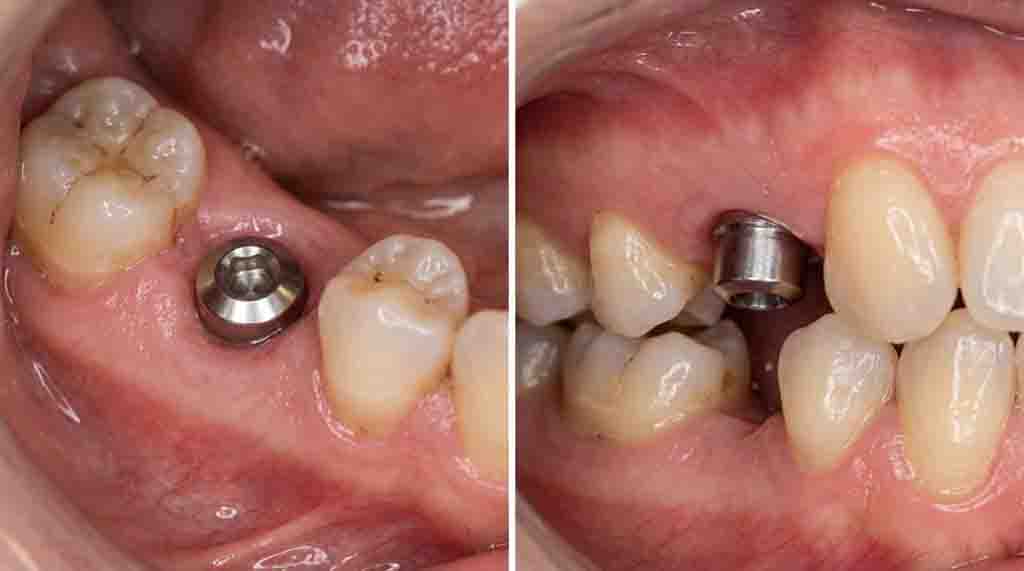
Here are some dental implant healing cap pictures:
Why Do Dentists Use a Dental Implant Healing Cap?
Once your dentist places the implant into the jawbone, the bone and implant need time to fuse together, a process called osseointegration. A cap serves a few practical purposes during that stretch.
Here is why dentists use a dental healing cap:
- It covers the top of the implant and acts as a barrier that lowers the risk of infection at the site while it heals.
- It keeps the top of the implant clear so the gum does not grow over it too soon. If it does, the final crown becomes harder to place.
- It shapes the gum into a natural curve, so the crown that goes in later looks like a real tooth.
- It gives your dentist easy access to check the site and make small adjustments at follow-up visits.
Your dentist usually places the cap at the end of the surgery, or shortly after, once the dental implant is stable enough to support it. Later, once healing is far enough along, your dentist removes the cap and replaces it with the permanent abutment that holds your final crown.
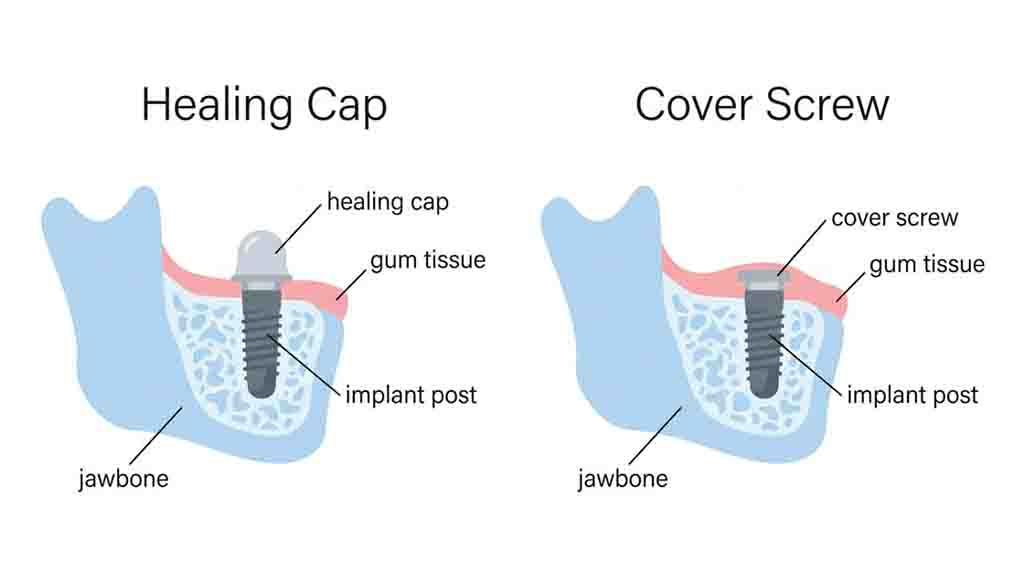
Healing Cap vs. Cover Screw: What Is the Real Difference?
| Healing Cap | Cover Screw | |
| Where it sits | Above the gumline | Buried beneath the gum |
| Can you see or feel it? | Yes | No, not until it is uncovered |
| Healing approach | Exposed healing | Two-stage healing |
| What the choice depends on | Bone quality, implant location, clinical judgment | Same factors, decided case by case |
Exposed healing means the cap stays visible in your mouth the whole time, so your dentist can check the site at regular visits without another procedure. Two-stage healing works differently. The implant stays fully closed under the gum while it fuses with the bone, and once healing is far enough along, a short second procedure reopens the site and a cap goes in from there.
In some cases, dentists choose a cover screw dental implant approach instead of an exposed healing cap implant. That choice comes down to bone quality, where the implant sits, and clinical judgment, not one method being the better one across the board.
How Does the Procedure Work?
A healing cap on implants can go in one of two ways, depending on your case.
In a one-stage approach, the dentist attaches the healing cap at the same time as the implant itself. The cap stays in place the whole time the implant fuses with the jawbone, which usually takes a few months, and the dentist removes it only once that healing is complete.
In a two-stage approach, the dentist leaves the implant fully covered and undisturbed while it fuses with the jaw first, a stage that also usually takes a few months. Once that is done, a short second procedure reopens the site with a small incision, and the dentist attaches the healing cap. This time the cap only stays for a few more weeks, just long enough for the gum to shape itself around it.
Either way, once the gum is ready, the dentist removes the cap without further surgery, and the permanent abutment and crown go in its place. For some patients, the two-stage approach means fewer procedures overall, though the right approach for you depends on your case and your treating dentist’s judgment.
Do Some Implants Not Need Healing Caps?
Most cases use a healing cap for dental implant healing, but not everyone does. Your dentist may skip this step when a temporary crown or bridge already covers the site, or when the case calls for immediate loading instead of a separate healing stage. The right choice depends on your treatment plan, so ask your dentist directly if you are not sure whether you have one.
How Long Does a Healing Cap Stay In Place?
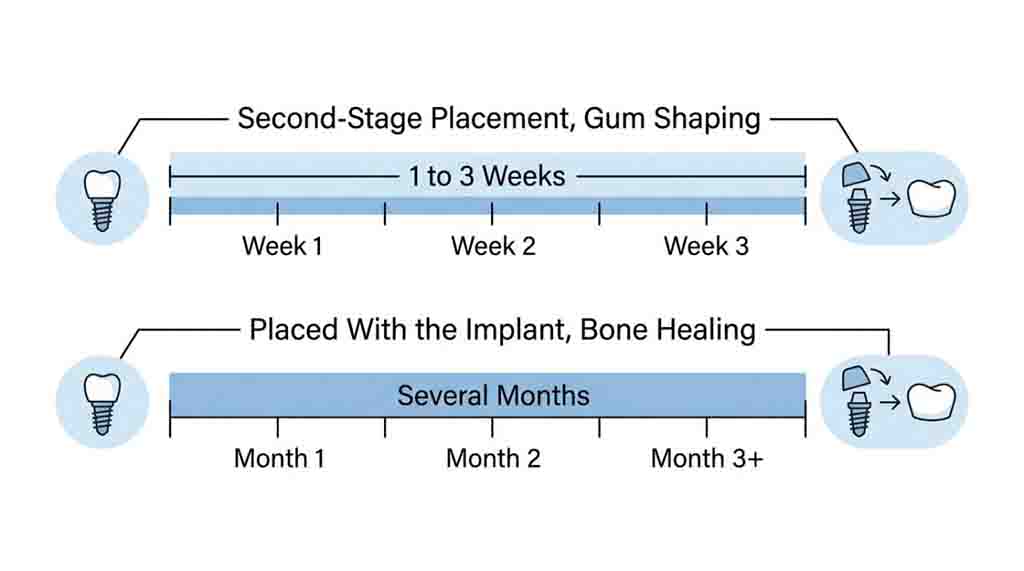
How long an abutment healing cap implant stays in place depends on which protocol your dentist used, not on one fixed number for every patient. Here is how the two scenarios compare:
- A cap placed at a second-stage surgery, purely to shape the gum before the crown stage, usually stays about one to three weeks, a short gum-shaping period.
- A cap placed alongside the implant itself, while it is still fusing with the bone, can stay several months instead.
Bone density, whether you needed a bone graft, and which protocol stage your implant is in can all push that timeline longer. Your dentist confirms your exact timeline, since healing speed and protocol both vary by case.
Implant Healing Cap Aftercare Instructions
Mild pressure, slight soreness, and a tight feeling around the cap are common in the first few days, easing within one to two weeks. Good dental implant healing cap care during this time helps the site heal well.
A few steps make a real difference:
- Brush gently around the cap with a soft toothbrush rather than skipping that spot.
- Rinse with warm salt water or the rinse your dentist gave you, and keep it gentle.
- Skip hard or crunchy food on that side of your mouth until your dentist clears it.
- Attend every follow-up visit, since your dentist checks the cap and tissue at each one.
Is It Normal for Gums to Grow Over a Healing Cap?
Some gum growth over the cap can happen, and in most cases it is a normal part of healing, not a sign that something went wrong. Still, it is worth a check. If the cap becomes fully covered, your dentist can adjust or replace it so healing stays on track. Call your dentist if the cap disappears under the gum, or if the area becomes painful, swollen, or does not improve.
Let’s Wrap It Up
A healing cap is a small but important part of your recovery after replacing a missing tooth with an implant. Some pressure and some change in the gum around it are usually part of normal healing, not a problem.
At My Dental & Implants, we help patients understand every stage of implant healing, including what is normal to feel with a healing cap in place. Anyone with questions about their own recovery can call our dental office at (623) 300-2550 and describe what they are experiencing before they decide whether to book an appointment.
FAQs
What is a healing cap?
A healing cap is a small, dome-shaped part your dentist places over a dental implant while the site heals. It protects the implant and shapes the gum around it until your permanent crown is ready.
Is a healing cap the same as a healing abutment?
Yes. A healing cap and a healing abutment are two names for the exact same part. Both sit above the gumline and do the same job while the implant heals.
What does a healing cap do?
It protects the implant site from bacteria and food debris, and it guides the gum into a natural shape around the implant. It also gives your dentist easy access to check the area.
How long does a healing cap stay in?
It depends on the protocol, from one to three weeks for gum shaping alone up to several months when it goes in with the implant.
Does a healing cap hurt?
Most patients feel mild pressure or slight soreness for the first few days, easing within one to two weeks. It is not usually painful, though some tenderness is a normal part of healing.
What happens if a healing cap falls out?
Call your dentist right away, since the exposed implant needs protection. Your dentist can clean the area and put a new cap in place quickly, usually without additional surgery.
What does a dental implant healing cap look like?
It is a small, rounded, dome-shaped piece, usually metal or a tooth colored material, that sits flush with the gum. Most people barely notice it once healing settles in.
Are healing caps on dental implants necessary?
Most implant cases use one, since it protects the site and shapes the gum properly. In a few specific cases, your dentist may decide a healing cap is not needed.
Why are healing caps important?
They protect the implant while it fuses with the bone and help the gum settle into a natural shape for the future crown.
How long is the healing cap worn?
The length varies by case, generally one to three weeks for gum shaping alone, and several months, sometimes longer, with a bone graft, when placed during initial bone healing.
Share this Article

Dr. Nima Afzalian's
Dr. Nima Afzalian's
journey in dentistry began at 12 when he experienced the transformative power of
dental care during a tooth-filling procedure. That pivotal moment ignited his passion for dentistry, and
he has since dedicated his life to making a difference in people's lives by relieving pain and
discomfort through his expertise.
Nima earned his bachelor's and master's degrees in Biomedical Engineering from the
prestigious Barrett
Honors College at Arizona State University. Subsequently, he obtained his dentistry doctorate
from the
Midwestern College of Dental
Medicine, graduating with honors, with recognition in Dental Implants and
the Dean's Award as the Top Clinician of his class.
With his extensive education, clinical excellence, and genuine dedication to patient well-being, Dr.
Nima Afzalian is excited to provide you with the highest level of care for all your dental needs. When
you choose Dr. Nima, your oral health is in capable hands!
Success Stories
We are blessed with clients and patients who are loyal to us and have the nicest things to say about us.
Translate »