
27
Jul
Dental Implants With Bone Loss: Is It Possible?
Reviewed by Dr. Nima Afzalian, DDS
Last Updated: July 2026
Reading Time: 10 Minutes
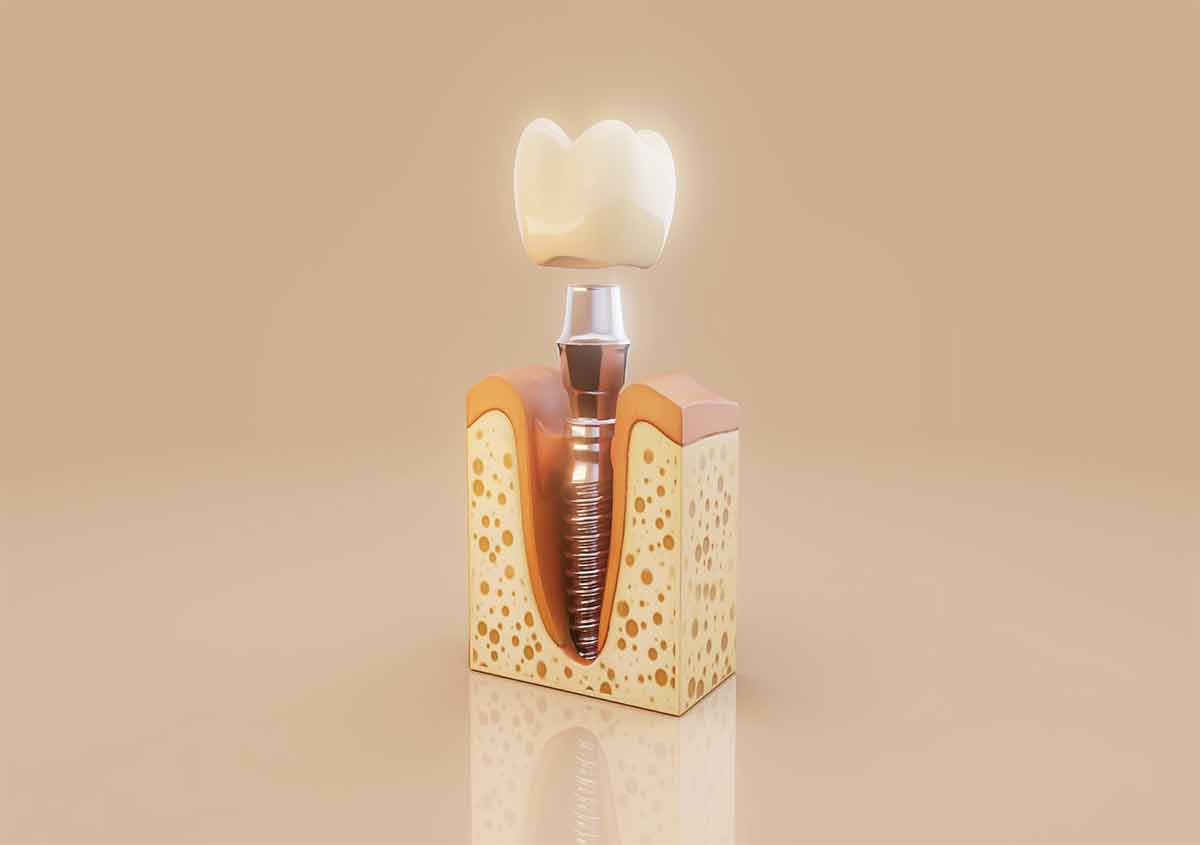
If a dentist has told you that you have bone loss and might not qualify for a dental implant, you are not alone. Missing teeth, gum disease, and age can all shrink the jawbone over time.
Can you get dental implants with bone loss? In most cases, yes. Bone loss usually just means a few extra steps, not that implants are off the table.
In this blog, how much bone you actually need for an implant, your options if you have bone loss (including grafting, sinus lifts, zygomatic implants, and All-on-4), realistic timelines and costs, and what to expect at a consultation.
Osteoporosis and Dental Implants
Osteoporosis is a condition that makes your bones weak and thin, including the bones in your jaw. Some people call this oral osteoporosis when it affects the mouth and jaw. It happens more often in older adults and in women after menopause.
Having osteoporosis does not stop you from getting a dental implant. An implant study of nearly 160,000 dental implants, including more than 45,000 placed with a bone graft, found a 97.8 percent success rate for the grafted implants, almost the same as implants placed without one.
Dr. Afzalian’s Note: Some patients get bisphosphonates through an IV instead, usually for cancer treatment. IV bisphosphonates raise the risk of a rare jaw problem called osteonecrosis. Always tell your dentist about every medicine you take, even ones that don’t seem related to your teeth.
How Much Bone Do You Need for Dental Implants?
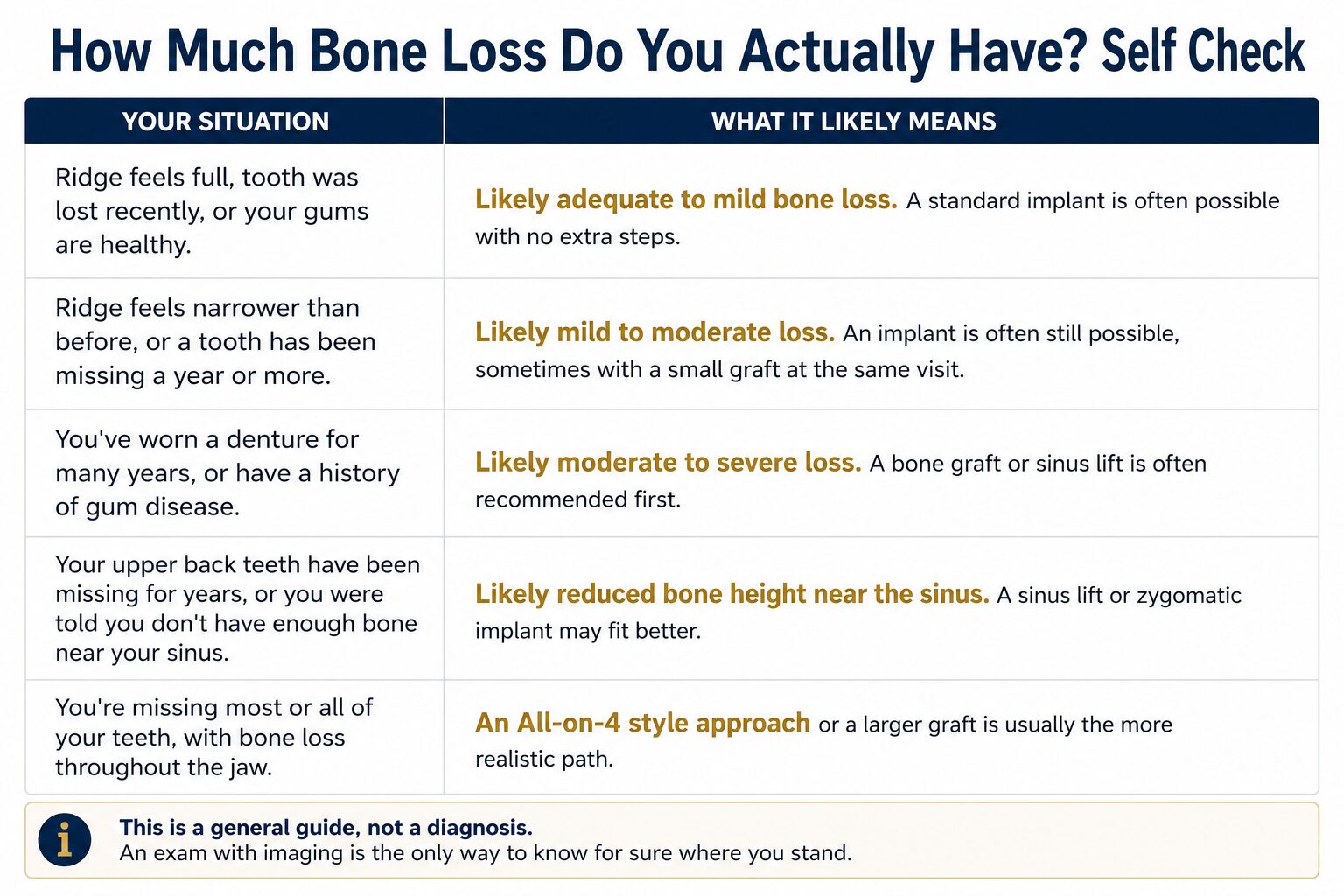
A standard implant generally needs about 5 to 6 millimeters of bone width and at least 10 millimeters of height. That gives it enough room to sit securely and stay clear of your sinuses and nerves.
Dentists usually describe bone loss in three simple levels:
| Bone loss level | What it looks like | Approximate bone size | Are implants possible? |
| Adequate bone | The ridge of your jaw is full and rounded | About 6mm or more wide, 10mm or more tall | Yes. A standard implant is usually possible with no extra steps. |
| Mild to moderate loss | The ridge has narrowed or lost some height | About 4 to 6mm wide | Often yes. Sometimes with a small graft added during the same visit. |
| Severe loss | The ridge is flat, or bone has worn down close to the base of the jaw | Less than 4mm wide, or a big loss in height | Usually yes, but it calls for a bigger graft, a sinus lift, or one of the specialist options covered below. |
Can You Get Dental Implants With Severe Bone Loss?
Yes. Most people with severe bone loss can still get dental implants. Your dentist will either work with the bone you already have or rebuild bone first with a graft, then place the implant. Which path is right for you depends on how much bone is left and where it’s missing.
Working With the Bone That’s Already There
Upper jaw dental implants for bone loss:
- Zygomatic implants: These anchor into your cheekbone instead of your upper jaw, bypassing the bone you’ve lost. Dentists use them for severe upper jaw bone loss when you want to avoid a lot of grafting.
- Pterygoid implants: These sit at an angle in a dense part of bone toward the back of your upper jaw. Dentists usually place them alongside other implants as part of a full set of teeth, not on their own.
- Trans-sinus implants: These pass through the sinus into bone near your nose. Only certain jaw shapes allow this option.
- Pink porcelain rebuilding: This recreates the look of lost gum and bone using gum colored porcelain built into a full set of replacement teeth, without adding any real bone.
These upper jaw options are advanced procedures. Most general dentists refer patients to an oral surgeon or a prosthodontist with specific training in them, and they’re usually reserved for more serious cases.
Lower jaw dental implants with bone loss:
- Subperiosteal implants: This custom-made frame sits on top of your jawbone instead of inside it. Dentists use it when there isn’t enough bone for a standard implant, and grafting isn’t a good fit.
- Nerve repositioning: Your dentist carefully moves the nerve running through your lower jaw to make room for a longer implant. This carries a real chance of temporary numbness in your lip or chin, and less often, lasting numbness, so dentists only use it after a careful evaluation.
These approaches can shorten the road to a stable, natural-feeling smile, but they carry their own risks and aren’t the right fit for everyone.
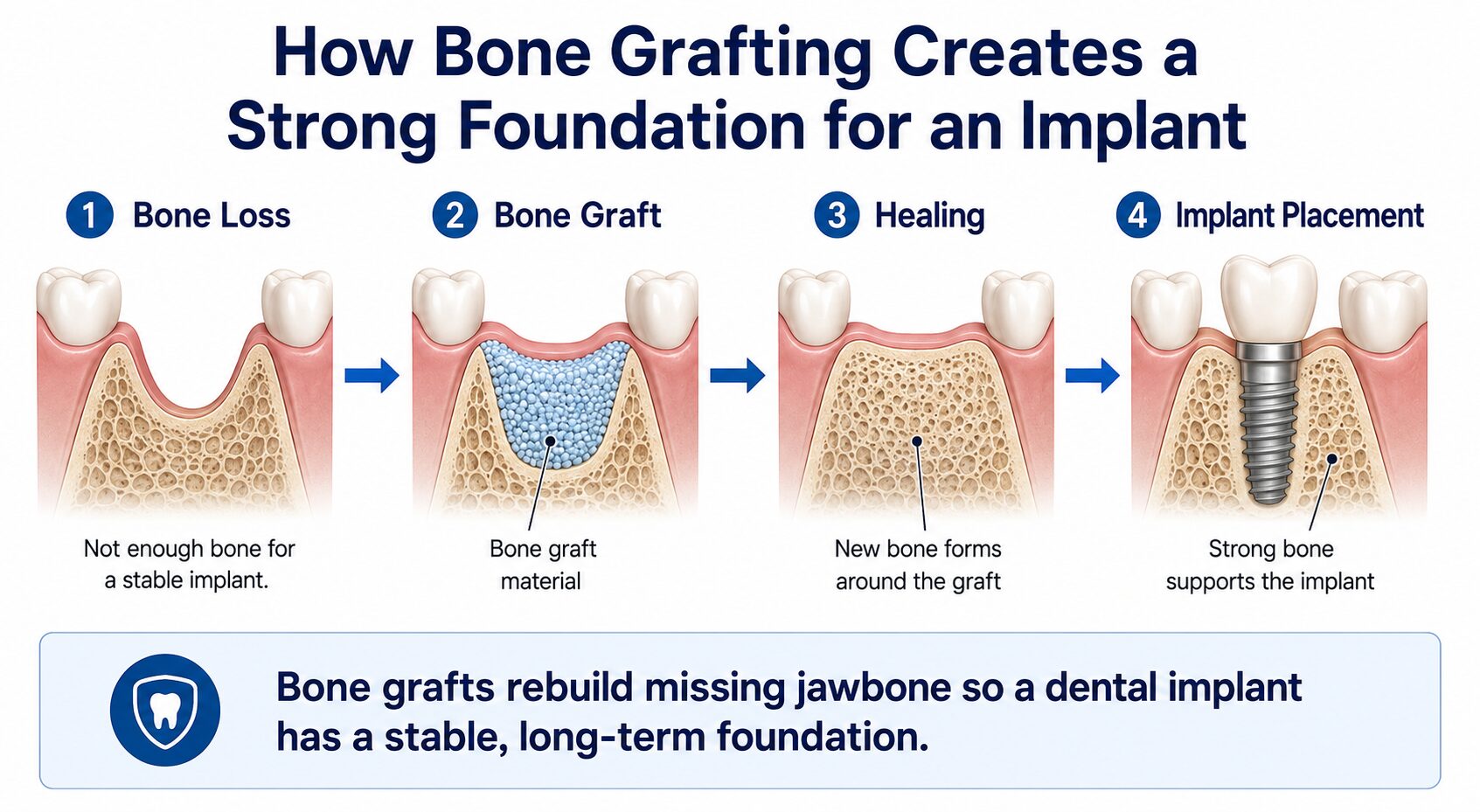
Bone Grafting for Dental Implants
A bone graft for dental implants adds material to rebuild the width or height of bone you’re missing, so the implant has something solid to hold onto. There are four common types of graft material:
- Autogenous: Bone taken from your own body, usually from the chin, jaw, hip, or shin.
- Allograft: Bone from a human donor, processed and cleaned by a bone bank. This type is safe and well studied.
- Xenograft: Bone from cattle, used successfully in dentistry for years.
- Alloplast: Man-made bone material, usually reserved for smaller grafts since it doesn’t bond with your own bone quite as well as real bone does.
Smaller grafts usually heal in about 3 to 4 months. Larger grafts can take 4 to 6 months or longer. Waiting too long after a graft has healed, generally past 6 to 12 months, can let the new bone start to shrink again, so timing the implant matters.
Sinus Lift for Dental Implants
A sinus lift is a type of bone graft used specifically in the upper back jaw, where the sinus sits close to the bone. It raises the sinus floor and adds bone material underneath, creating room for an implant once it heals. This is often recommended for people who need an upper molar implant but have lost bone in that exact spot. Healing usually takes about 4 to 6 months before the implant goes in.
Mini and All-on-4 Dental Implants for Bone Loss
All on 4 implants use four implants placed at an angle to make the most of the bone that’s already there. This can lower or remove the need for a bone graft when replacing a full set of teeth.
Mini dental implants are narrower than standard implants and can sometimes work with less bone, often to hold a lower denture in place.
At My Dental & Implants, we offer mini implants for patients dealing with bone loss, along with All-on-4 and snap-in denture options.
How Long Does the Whole Process Take?
| Bone loss level | Typical timeline |
| Mild | About 3 to 6 months total, mostly implant placement and healing with little to no grafting. |
| Moderate | About 6 to 10 months total, including graft or sinus lift healing, then implant healing. |
| Severe | About 8 to 12 months or more. Larger grafts and sinus lifts need more healing time, though specialist options like zygomatic implants can sometimes shorten this by skipping a separate grafting stage. |
Dr. Afzalian’s Note: These are averages, not guarantees. Smoking, uncontrolled diabetes, and how closely your healing is checked can all change your personal timeline.
Benefits of Dental Implants for Patients With Bone Loss
- Chewing pressure from the implant helps protect the bone you have left, the same way a natural tooth root does.
- You get a stable, natural feeling chewing without denture adhesive.
- Your facial structure and support are better preserved than if the gap is left untreated.
- Implants tend to last for decades and don’t need the repeated refitting dentures can require as your jaw keeps changing shape.
- Most patients feel more confident and comfortable once healing is complete.
Dental Implants for Diabetics With Bone Loss
Diabetes can affect your bone strength and how fast you heal. Both of these matter if you already have bone loss. What matters most is how well you control your blood sugar, not just having diabetes.
If your diabetes is well controlled, usually an HbA1c under 7 to 8 percent, your implant success rate is close to people without diabetes, often in the mid-90 percent range. If your diabetes is poorly controlled, with a higher HbA1c, you heal slower and face a bigger chance of implant failure.
A few things can help if you have diabetes:
- Work with your doctor to control your blood sugar before surgery.
- Expect healing to possibly take longer than usual.
- Keep up with closer dental checkups after your implant is placed.
Diabetes is something to plan for with your dentist. It is not a reason to say no to implants.
Dental Implants With Bone Loss Cost
The cost of getting dental implants with bone loss is more than a standard implant because grafting adds its own fee on top. The total depends on how many implants you need, whether a graft, sinus lift, or specialist technique comes first, and what kind of replacement teeth go on top, whether that’s a single crown, a bridge, or a full set of teeth.
Overcome Bone Loss – Implant Consultation Near Me in Glendale
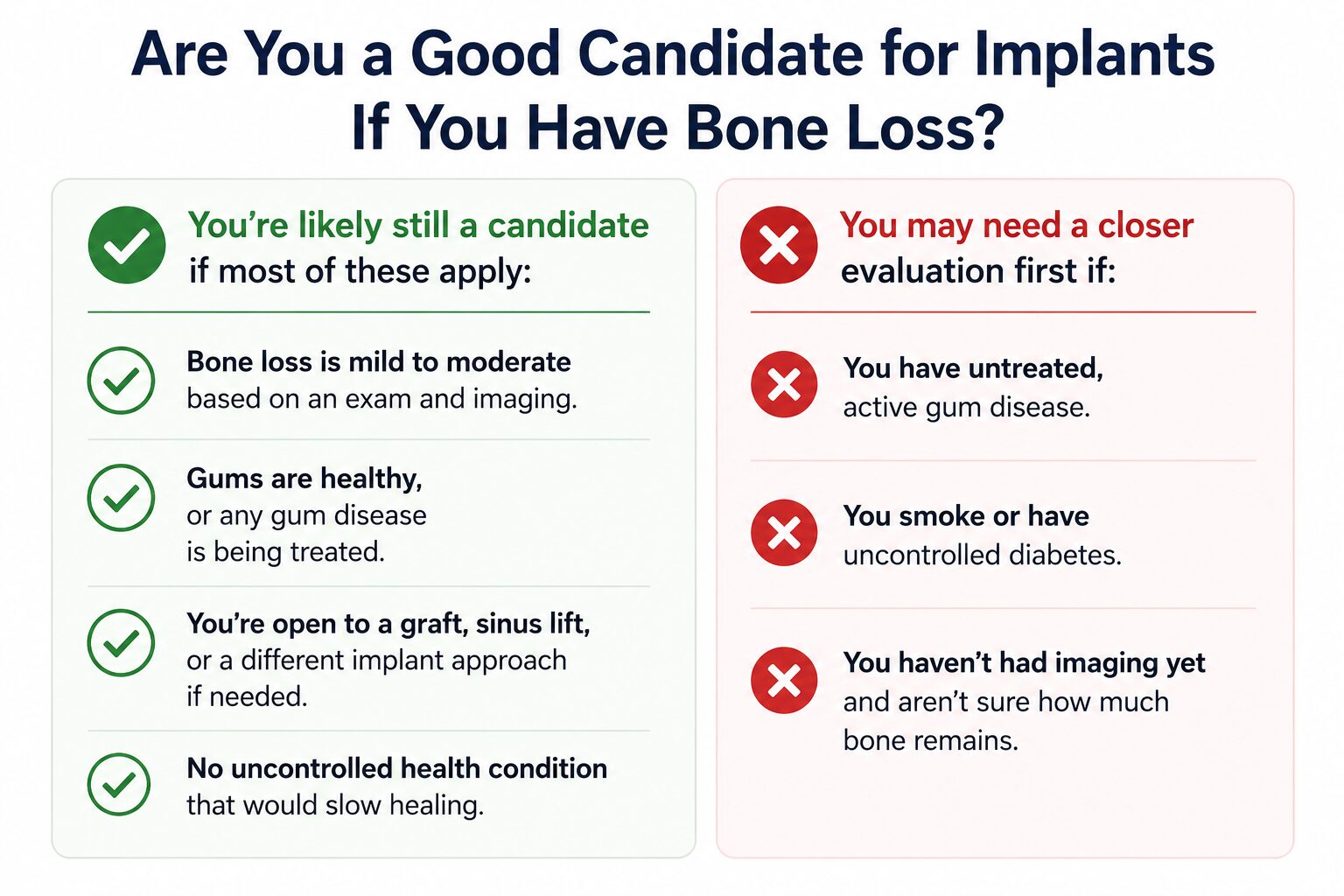
At My Dental & Implants, Dr. Nima Afzalian starts with an exam and a review of your health history. From there, an X-ray or 3D CBCT scan measures exactly how much bone you have left. He then walks you through which path fits your case in plain language, whether that’s a standard implant, a graft, a sinus lift, a specialist option, or All-on-4.
To offer the best Glendale dental implant results, Dr. Afzalian’s checks:
- How much bone you have left
- The health of your gums
- Factors that affect healing, such as smoking, diabetes, or osteoporosis medication
- Whether grafting, a sinus lift, or a specialist implant approach fits your case best
At My Dental & Implants, we help patients in Glendale, Peoria, Phoenix, Surprise, Sun City, and the surrounding West Valley figure out whether a standard implant, a bone graft, or an option like All-on-4 is the right way to replace a missing tooth.
Visit us at 6637 West Peoria Ave, Suite D-2, Glendale, AZ, 85302, or call us at (623) 300-2550 to schedule your consultation.
FAQs
Can you have dental implants with severe bone loss?
Often yes. Severe bone loss dental implants usually mean the plan shifts toward a bigger graft, a sinus lift, a specialist option like a zygomatic or pterygoid implant, or an All-on-4 style approach instead of a standard single implant.
What should you do if you don't have enough bone for dental implants?
Start with an exam and imaging to see exactly how much bone is missing. From there, your dentist can recommend a graft, a sinus lift, mini implants, or an approach built to work around thinner bone.
Can you have dental implants with 80 percent bone loss?
It depends on exactly where the bone loss is and how much remains. Very advanced bone loss usually calls for a specialist technique, like a zygomatic or subperiosteal implant, rather than a standard implant. Imaging is the only way to know for sure.
Can you get implants after losing a tooth years ago?
Often yes. The longer a tooth stays missing, the more bone tends to shrink, but a graft or an alternative implant approach can usually still build a stable foundation.
Can dental implants prevent further bone loss?
Yes. Once placed, an implant brings back the chewing pressure a natural tooth root used to provide, which helps protect the bone around it. A missing tooth left unreplaced will keep losing bone over time.
How long do you have to wait between a bone graft and getting the implant?
Usually about 3 to 6 months for smaller grafts, and 4 to 6 months or more for larger grafts or sinus lifts.
Share this Article

Dr. Nima Afzalian's
Dr. Nima Afzalian's
journey in dentistry began at 12 when he experienced the transformative power of
dental care during a tooth-filling procedure. That pivotal moment ignited his passion for dentistry, and
he has since dedicated his life to making a difference in people's lives by relieving pain and
discomfort through his expertise.
Nima earned his bachelor's and master's degrees in Biomedical Engineering from the
prestigious Barrett
Honors College at Arizona State University. Subsequently, he obtained his dentistry doctorate
from the
Midwestern College of Dental
Medicine, graduating with honors, with recognition in Dental Implants and
the Dean's Award as the Top Clinician of his class.
With his extensive education, clinical excellence, and genuine dedication to patient well-being, Dr.
Nima Afzalian is excited to provide you with the highest level of care for all your dental needs. When
you choose Dr. Nima, your oral health is in capable hands!
Success Stories
We are blessed with clients and patients who are loyal to us and have the nicest things to say about us.
Translate »