
24
Nov
Does Dental Implant Hurt?
Table of Contents
- Are Dental Implants Painful: Quick answer
- Do Dental Implants Hurt During the Procedure?
- Before Your Visit Checklist
- Do Dental Implants Hurt After the Surgery?
- How Does Implant Pain Compare to Other Dental Procedures?
- Factors That Influence Dental Implant Pain Levels
- Tips for a Comfortable Healing Process After Implant Surgery
- When to Contact Your Dentist About Dental Implant Pain
- Let’s Recap
Many people search for “does dental implant hurt” before they book a visit, and the answer is good news. Most people feel pressure, not pain, because the dentist numbs the area first. Some soreness after surgery is normal, and it gets better as you heal.
In this guide, My Dental & Implants explains what to expect at each step, from the visit to healing, so you know what feels normal and when to call your dentist.
Are Dental Implants Painful: Quick answer
| When | What most people feel | What to do |
| Day of surgery | Pressure and vibration while the area is numb. Soreness starts afterward and peaks about 6 hours after surgery. | Tell your dentist at once if you feel sharp pain during the visit. |
| Days 1 to 3 | Soreness is strongest. Puffy cheeks peak about 48 hours after surgery. | Follow your dentist’s care and pain relief steps. |
| Days 4 to 7 | Soreness fades. | Eat soft foods and keep the area clean. |
| Weeks 1 to 2 | Little soreness is expected. | Call your dentist if pain returns or gets worse. |
| Months of healing | The bone grows around the implant, which can take up to several months. New pain is not expected. | Go to every follow-up visit. Call the office if pain starts. |
Do Dental Implants Hurt During the Procedure?
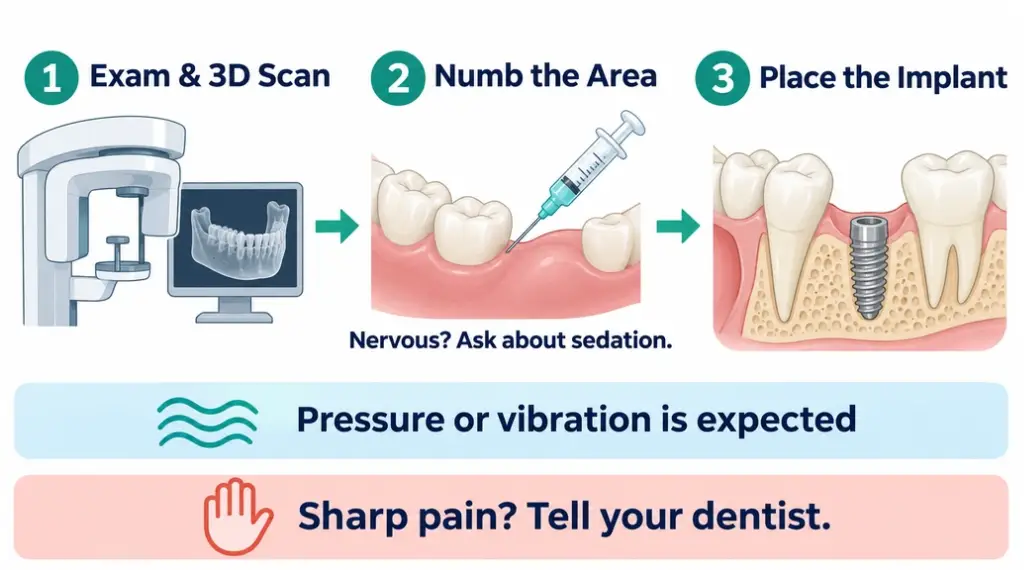
Your dentist numbs the area first, so you should feel pressure and vibration, not sharp pain. Local anesthesia and sedation options are available for patients who feel nervous. The visit starts with an exam and a 3D scan to plan your implant.
Then the dentist numbs the area and places the dental implant. If you feel sharp pain at any point, say so. The dentist can numb the area more or adjust your dental sedation.
Before Your Visit Checklist
A little planning makes recovery easier. Here are four things to do before your implant surgery.
- Arrange for a driver if you will be sedated. You need a ride home after oral or IV sedation.
- Stock soft and cold foods, such as yogurt, soup, and applesauce.
- Tell your dentist about every medicine you take, including over-the-counter drugs and supplements.
- Fill any prescription before the day of surgery so you have it when you get home.
Do Dental Implants Hurt After the Surgery?
Some soreness and puffiness are normal. One review found that pain peaks about six hours after surgery and puffiness peaks about 48 hours after. The American Dental Association (ADA) lists implant surgery as moderate expected pain.
Yet in studies of people who had both a tooth extraction and an implant, they reported less pain after the implant. These are study findings, so your experience may differ.
Pain changes over the first days and months after surgery, so here is what to expect along the way:
- Pain peaks about six hours after surgery.
- Puffiness peaks about 48 hours after surgery, so your cheek may look puffiest on day two.
- Soreness is usually strongest in the first few days and fades through the first week.
- Over the next months, the bone grows around the implant, and the ADA says this can take up to several months. You should not feel new pain during this time, so call your dentist if pain starts or gets worse.
This pain timeline is one part of the full implant process. It starts with tooth extraction, then healing or a bone graft if needed. Next the dentist places the implant, which is when soreness is strongest. Then the bone bonds with the implant, and your implant crown is attached. Most implants take 3 to 6 months from placement to final crown, though healing time varies.
Some people get an implant on the same day as the extraction if the dentist agrees, but this can cause more discomfort. Pain that returns or gets worse after the first few days is not expected, so tell your dentist right away.
How Does Implant Pain Compare to Other Dental Procedures?
Most people feel moderate pain after a dental implant. The American Dental Association (ADA) rates how much pain dentists expect after common procedures. Here is how those procedures compare with a dental implant. Your own pain may be different.
| Compared with a dental implant | Procedures |
| Usually less pain | Root canal, deep cleaning, simple tooth removal, gum trimming |
| About the same | Surgical tooth removal, root canal surgery, gum flap surgery |
| Usually more pain | Wisdom teeth stuck in bone, gum surgery, complex implant surgery |
The ADA rates simple tooth removal as mild, yet patients who had both a tooth removed and an implant placed reported significantly less pain after the implant surgery.
Factors That Influence Dental Implant Pain Levels
Pain after implant surgery is not the same for everyone. Most people feel mild soreness, but some feel more discomfort for a short time. A 2021 review in the International Journal of Dentistry, which looked at pain after implant surgery, found that several things make discomfort more likely. Knowing these factors can help you plan for your comfort with your dentist, and these are the main ones:
- Getting more than one implant
- Needing a bone graft or a sinus lift
- Having a longer surgery
- Getting an implant at the back of the mouth
- Having the implant placed on the same day as the extraction
- Being older
- Smoking
- Feeling worried about pain
Does Same-Day Implant Placement Hurt More?
It can. Getting an implant on the same day as the tooth extraction is one of the factors that may cause more discomfort. Your dentist can tell you if this option fits your case. You can also read our article on the dangers of one day dental implants before you decide.
Tips for a Comfortable Healing Process After Implant Surgery
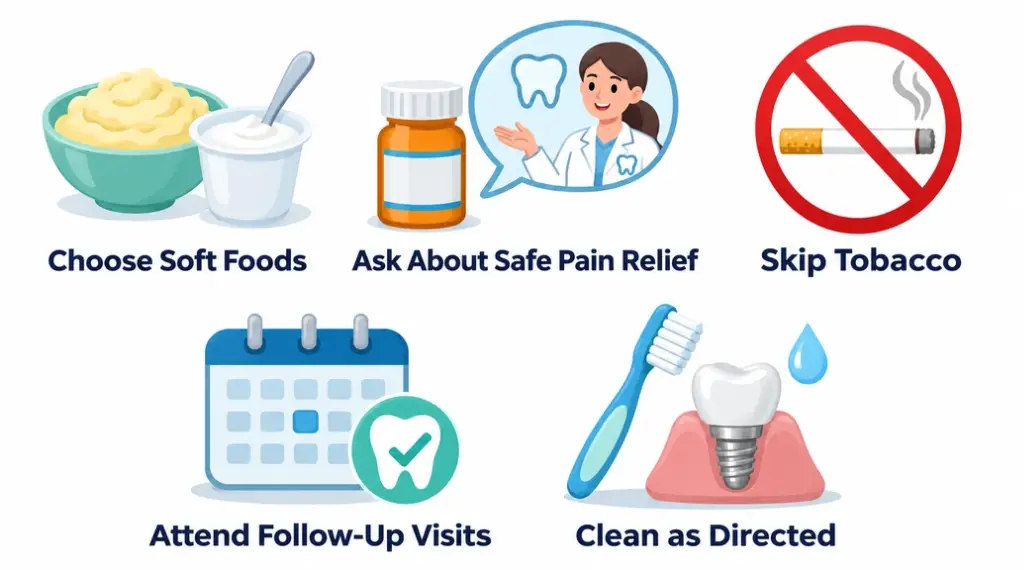
Healing after dental implant surgery goes more smoothly when you follow a few simple steps at home. Your dentist will give you care steps that fit your case, and these tips can support them. Here are a few ways to stay comfortable while you heal:
- Eat soft foods, cold foods, and warm soup if your dentist suggests them.
- Ask your dentist which pain reliever is safe for you. ADA-endorsed guidance names ibuprofen or naproxen, alone or with acetaminophen, as the first choice for short-term dental pain, before stronger medicines like opioids.
- Skip tobacco.
- Go to every follow-up visit.
- Keep up your home care so the area stays clean.
Your dentist reviews your health history and medicines first, so ask before you take any pain reliever. Smoking after dental implant surgery can slow recovery, says the ADA. A 2021 review of 292 studies in the journal Medicina found that implants placed in smokers failed more often than implants placed in non-smokers. Ask your dentist how long to stay tobacco free.
When to Contact Your Dentist About Dental Implant Pain
Mild soreness and puffiness are normal after implant surgery, and they should ease over the first few days. Some signs mean your dentist should check the area, even if the surgery went well. Call the office if you notice any of these signs:
- Pain that gets worse after the first few days instead of better
- Fever
- Pus or a bad taste
- Puffiness that keeps spreading
- An implant that feels loose
- Blood that does not stop
- Numbness that does not fade
If something feels off during your recovery, call us at (623) 300-2550 or book an appointment online. Our team at My Dental & Implants in Glendale, AZ can check your implant and guide your next steps. Get urgent care at once if puffiness makes it hard to breathe or swallow.
Let’s Recap
So, does dental implant hurt? Usually you feel pressure, not pain, at the visit, and soreness fades over a few days. Your dentist can plan for your comfort with local anesthesia and sedation options. If you would like to talk about your options, book a dental implant consultation at My Dental & Implants in Glendale, AZ. Our office also welcomes patients from Peoria, Phoenix, Surprise, Sun City, and Cave Creek.
FAQs
1. Do dental implants hurt forever?
No. Pain should fade as you heal, usually within the first week. Pain that lasts over 3 months is not normal, so tell your dentist.
2. How long should my dental implant hurt?
Most soreness fades within about a week. Pain that lasts longer or gets worse is not expected, so call your dentist.
3. Do dental implants hurt over time?
No. Pain usually gets less each day as the area heals. New or growing pain at any time is not expected, so call your dentist.
4. Why does my dental implant hurt when I chew?
It may be a loose crown, a bite that is off, or an infection. Call your dentist soon so they can check it.
5. Why does my tooth implant hurt years later?
A gum infection around the implant, a loose part, or a bite change may cause it. See your dentist soon for an exam.
6. Does a dental implant hurt more than a root canal?
Usually yes. The ADA expects mild pain after a routine root canal and moderate pain after implant surgery. Your own pain may differ.
Share this Article

Dr. Nima Afzalian's
Dr. Nima Afzalian's
journey in dentistry began at 12 when he experienced the transformative power of
dental care during a tooth-filling procedure. That pivotal moment ignited his passion for dentistry, and
he has since dedicated his life to making a difference in people's lives by relieving pain and
discomfort through his expertise.
Nima earned his bachelor's and master's degrees in Biomedical Engineering from the
prestigious Barrett
Honors College at Arizona State University. Subsequently, he obtained his dentistry doctorate
from the
Midwestern College of Dental
Medicine, graduating with honors, with recognition in Dental Implants and
the Dean's Award as the Top Clinician of his class.
With his extensive education, clinical excellence, and genuine dedication to patient well-being, Dr.
Nima Afzalian is excited to provide you with the highest level of care for all your dental needs. When
you choose Dr. Nima, your oral health is in capable hands!
Success Stories
We are blessed with clients and patients who are loyal to us and have the nicest things to say about us.
Translate »